Historical research column
The Mystery of Aisu Medicine
“Aisu no Kurogusuri” in the Tokitsugukyōki
What was 愛洲薬, repeatedly mentioned in Yamashina Tokitsugu’s diary 言継卿記, and does its name connect it to Aisu Hisatada or the Aisu family? The starting point is 愛洲之黒薬 in 1548. The diary’s recorded actions come before any proposed origin. “Aisu medicine” is a descriptive label here, not an established English historical name.
Primary-source wording
愛洲之黒薬 in Tenbun 17 (1548)
The entry for Tenbun 17 (1548), first month, day 21, in volume two of 言継卿記 contains the passage below. This preserves the diary’s calendar date; it is not a conversion to 21 January in the Gregorian calendar.
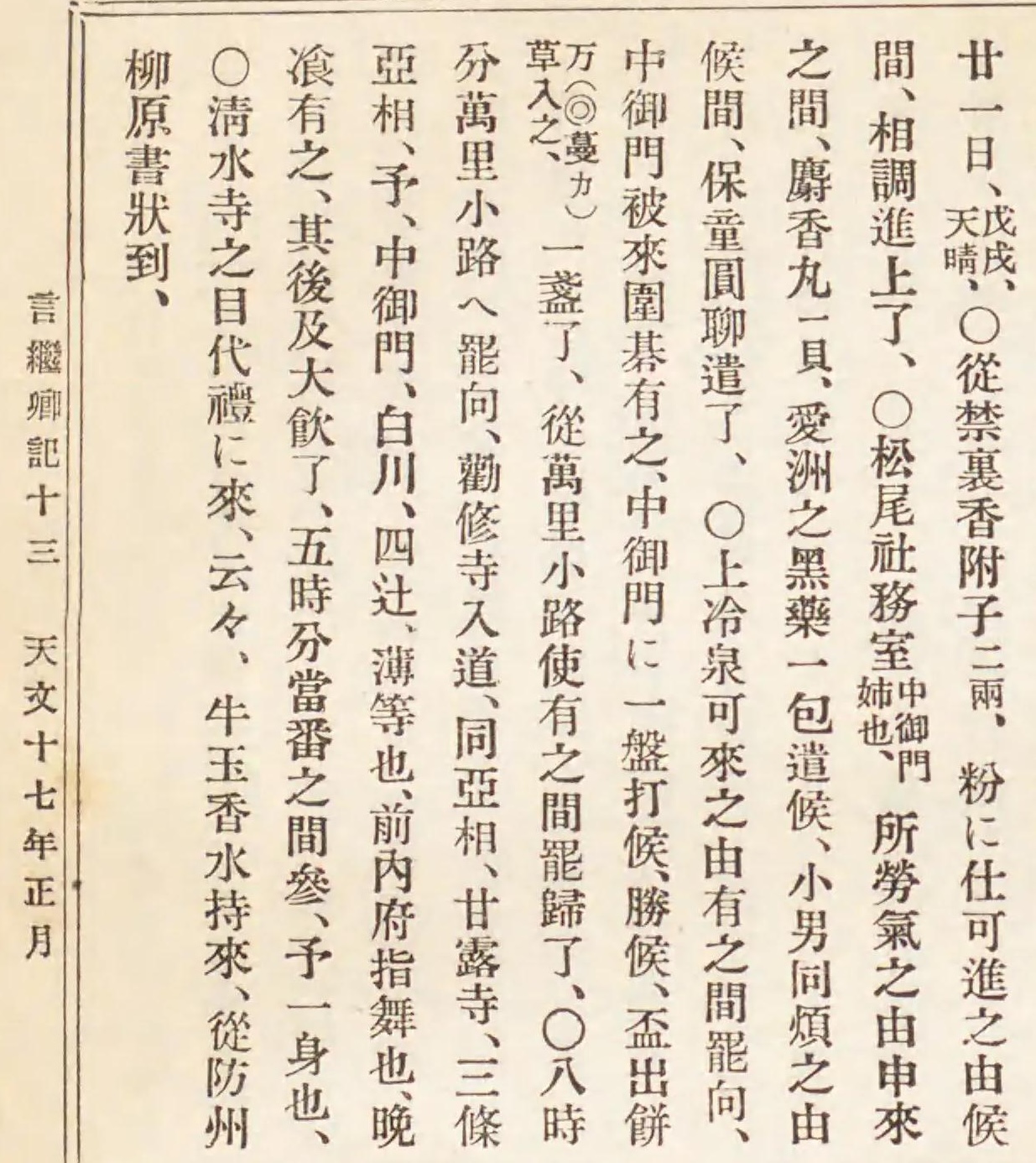
愛洲之黒薬一包遣候
The supplied research identifies this passage as visually confirmed in the scanned edition. It concerns medicines sent in response to illness; 麝香丸 and 保童圓 also appear nearby. Only the confirmed short passage is quoted here, without reconstructing a continuous surrounding transcription.
The direct evidence is that Tokitsugu sent one packet of a medicine called 愛洲之黒薬. He was already handling it, but this sentence does not identify its supplier, maker, or ingredients. It is an important early example confirmed in this research, not a demonstrated first occurrence in the whole diary.
Sources and references: Tokitsugukyōki (『言継卿記』), vol. 2
Naming and inference
From 愛洲之黒薬 to 愛洲薬?
The supplied research reports repeated use of the shorter name 愛洲薬 from the 1550s onward, with many related results in NDL full-text searches of volumes three and four. These are findings from the search environment used, not a philologically verified count of every occurrence in the diary.
The wording of 1548 strongly suggests a relationship with the later 愛洲薬. They may well refer to the same medicine, but no diary entry explicitly identifying the two as identical has yet been confirmed. Reading the earlier expression as a descriptive form related to a later established name is an inference from naming and chronology.
Quotations retain supplied characters such as 藥, while explanatory Japanese uses 愛洲薬. 黒薬 can be rendered literally as “black medicine”; it does not identify a chemical substance, recipe, or therapeutic effect.
Sources and references: Tokitsugukyōki (『言継卿記』), vol. 3 · Tokitsugukyōki (『言継卿記』), vol. 4
Actions recorded in the primary source
A medicine Tokitsugu compounded and distributed
The later supplied excerpts record two distinct actions: 一包遣之, sending one packet, and 調合了, completing compounding. Their individual volumes, pages, and dates remain under review, so neither passage is assigned to a volume here.
愛洲藥一包遣之
愛洲藥調合了
Together with the repeated entries summarized in the supplied research, these actions suggest that 愛洲薬 formed part of Tokitsugu’s practical medical activity: he possessed, compounded, and distributed it. The evidence does not establish him as a professional physician or demonstrate the medicine’s effectiveness.
Reported examples concerning wounds, illness, falls, and postpartum conditions remain research targets. Without verified individual texts and dates, no case-by-case quotations or list of therapeutic indications is supplied.
What the primary source establishes
A written 愛洲藥方
The entry quoted below distinguishes the medicine from an 愛洲藥方 that could be written and sent. Tokitsugu had sent it previously and wrote it out again when asked. It provides evidence for a written formula as well as packets of medicine.
The entry records the formula’s transmission; it does not reproduce its complete text or proportions. “Formula” is used cautiously and does not imply a modern pharmaceutical prescription.
Text and personal identification
Sending the formula again to Ōgo Musashi-no-kami
The supplied research tentatively places the following entry around 1571. Its year, exact date, volume, and page remain unresolved.
大胡武藏守來、愛洲藥方去年遣之、火事燒之間又所望之由申之間書遣之、同藥一包遣之
The text records a visit by 大胡武藏守, who requested the 愛洲藥方 again because the copy Tokitsugu had sent the preceding year had burned in a fire. Tokitsugu wrote and sent it again, along with one packet of the same medicine. The fire loss is recorded as Ōgo’s report.
The documented direction in this episode is Yamashina Tokitsugu → Ōgo Musashi-no-kami. It establishes that the formula passed from Tokitsugu to 大胡武蔵守; it does not identify its inventor or reconstruct all earlier transmission.
Ōgo Musashi-no-kami is commonly identified as Kamiizumi Nobutsuna, but that identification is distinct from direct proof in the diary. If the conventional identification of Ōgo as Nobutsuna is accepted, this entry would indicate transmission of the formula from Tokitsugu to Nobutsuna. That conclusion is conditional on the identification.
Chronology and evidence
A timeline beginning in 1548
Secure dates are distinguished from periods supplied by the research. Undated leads appear last, without inferred intervals between events.
Tokitsugu was already using 愛洲之黒薬 more than twenty years before the securely identified diary appearances of Kamiizumi Musashi-no-kami Nobutsuna in 1570. An account treating their documented contact around 1570 as Tokitsugu’s first receipt of 愛洲薬 therefore requires chronological reconsideration.
This comparison includes an inference about the relationship between the medicine of 1548 and the later 愛洲薬. It does not exclude earlier contact with Kamiizumi or rule out every possible route of transmission.
| Year / period | Diary wording | Supported reading and limits |
|---|---|---|
| 1548 / Tenbun 17, first month, day 21 | Visually confirmed in supplied research愛洲之黒薬一包遣候Sources and references: Tokitsugukyōki (『言継卿記』), vol. 2 | An important early form confirmed in this research; one packet was sent. This is not a claim to the diary’s first occurrence. The date retains the diary’s calendar. |
| From the 1550s | Period from supplied research; individual dates pendingRepeated use of the name 愛洲薬 | The shorter name recurs. Its identity with the medicine of 1548 is an inference; no explicit equation in the diary has been confirmed. |
| 1560s (individual entry year pending) | Period from supplied research; supplied excerpt愛洲藥調合了 | Records compounding. The volume, year, and exact date of this particular excerpt remain unconfirmed. |
| 1570 (exact date unresolved) | Supplied excerpt reused from the Kamiizumi article上泉武藏守信綱來Sources and references: Tokitsugukyōki (『言継卿記』), vol. 4 | Names Kamiizumi Musashi-no-kami Nobutsuna explicitly, 22 years after the medicine entry of 1548. |
| Around 1571 (year pending) | Supplied excerpt; approximate research dating大胡武藏守來、愛洲藥方去年遣之、火事燒之間又所望之由申之間書遣之、同藥一包遣之 | Ōgo requests the formula again after its loss in a fire; Tokitsugu writes and sends it. 去年 means the preceding year relative to this entry, not a separately verified calendar year. |
| Later; year pending | Provisional readings awaiting collationResearch leads concerning materials and directions | Reported entries concern a material for the medicine and a board with its name, administration, and prohibitions. Uncollated wording and context are not treated as settled quotations or a reconstructed formula. |
Sources and references: Tokitsugukyōki (『言継卿記』), vol. 2 · Tokitsugukyōki (『言継卿記』), vol. 4
Unresolved research leads
Materials, administration, and prohibitions
The supplied research reports an entry apparently describing a bag of material sent by 松室中務大輔 for use in 愛洲薬. The material name 赤の小角豆 is a provisional reading whose characters remain unverified. It is not normalized to a botanical or chemical identification or used to reconstruct a recipe.
Another reported entry apparently concerns instructions to 大澤右兵衞大夫 to prepare the medicine’s name, directions for administration, and prohibitions on a board. A verified continuous text has not been supplied, so no quotation is reconstructed. Once checked, it may shed light on organized directions for use; for now it remains a research lead.
Interpretation and what remains unknown
Does “Aisu” mean Aisu Hisatada?
The answer remains unknown. 愛洲 is also the surname of the historical Aisu family and of Aisu Hisatada / 愛洲移香 in traditions associated with Kage-ryu. The supplied research notes associations with the medicine in later martial-arts historiography as background for investigation. Individual publications and their arguments still require direct review.
No currently confirmed entry in 言継卿記 explicitly says that the medicine was transmitted by 愛洲久忠 or 愛洲移香, or that it was a medicine of 陰流. The name can suggest the Aisu family or Hisatada, but a shared name alone cannot establish that the medicine came from him.
The 之 in 愛洲之黒薬 can suggest attribution, provenance, association, or possession more visibly than the later, apparently consolidated name 愛洲薬. This is linguistic and historical interpretation. It establishes neither what “Aisu” designates—a person, a family, or another referent—nor personal authorship by Hisatada.
Present findings
Evidence for medicine and formula; an unresolved origin
The supplied primary-source excerpts support the sending of 愛洲之黒薬 in 1548, later distribution and compounding of 愛洲薬, and Tokitsugu’s renewed transmission of a formula to Ōgo Musashi-no-kami.
The relationship between the early and later names, and the medicine’s place in Tokitsugu’s continuing medical activity, are inferences. The origin of the name, complete formula, relationship to Hisatada, and links to Kage-ryu or Shinkage-ryu transmission remain unknown.
No direct evidence currently examined establishes a martial secret medicine or battlefield medicine. Evidence for a medicine and its formula is kept distinct from a narrative of martial transmission.
Scope of quotation review
Sources and research status
Quotations are based on research excerpts supplied on 6 September 2026. The supplied research identifies the 1548 passage as visually confirmed in a scan; independent collation by this site remains pending. Relevant pages and NDL frames are unresolved, as are the volumes and exact dates of the later medicine excerpts. The 1570 name entry is reused from the existing Kamiizumi article. The primary source is the historical diary 言継卿記; the NDL items provide access to digitized copies of the Kokusho Kankōkai printed edition, not the original manuscript. Volumes three and four are also listed as later search targets; unmapped medicine entries are not assigned to them by guesswork.
Further research will check the wording and context of the material and administration entries, volume/page/date coordinates, and the formula itself. Prior scholarship on the Aisu family remains under investigation. Relevant works by 中世古祥道 have not been read directly and are not cited as support for these conclusions. No discovery-priority claim is made.