History · Chapter 1
Chapter 1 | Kage-ryu — From the Surviving Documents
Beginning with the surviving Kage-ryu documents at the Tokyo National Museum, this chapter examines the documentary wording, transmitted accounts, technical system, and lineage associated with 愛洲移香 while keeping their evidence layers distinct.
Evidence
The surviving Kage-ryu documents
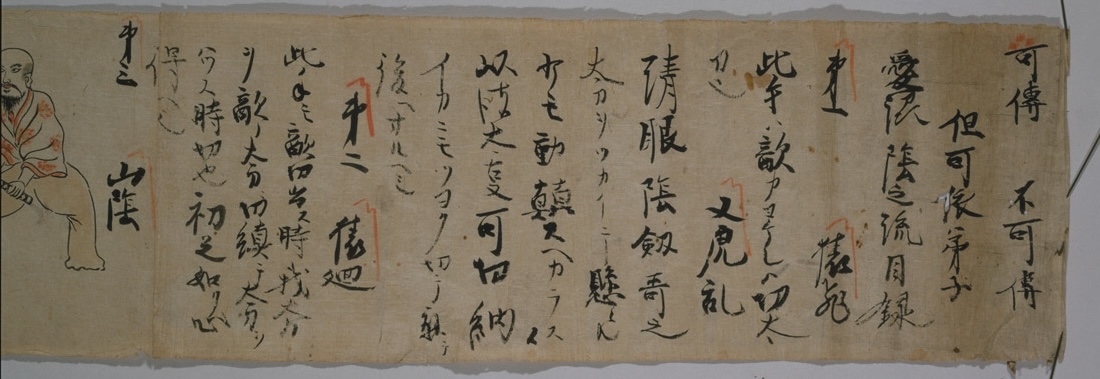
A group of scrolls concerning Kage-ryu survives at the Tokyo National Museum under collection number QA-3997. The museum management information identifies five scrolls containing technical illustrations, written passages, transmission information, and a transmission or genealogical diagram. The chapter begins with these objects, not with a retrospective history of origins.
Miyamoto and Uozumi frame their study around “four scrolls,” whereas the museum's QA-3997 management group contains five. This chapter does not assume that the two counts use an identical category or invent a one-to-one explanation for the difference.
- QA-3997/1『愛洲陰之流目録』
- copy dated Tenshō 10 (1582)
- QA-3997/2『[愛洲陰流秘伝書]』
- copy dated Tenshō 4 (1576)
- QA-3997/3『仕相之太刀』
- dated Tenshō 4 (1576)
- QA-3997/4『目かくし』
- copy attributed to the Muromachi period
- QA-3997/5『新当りう奥三ッ太刀』
- dated Tenbun 17 (1548)
Primary-source images
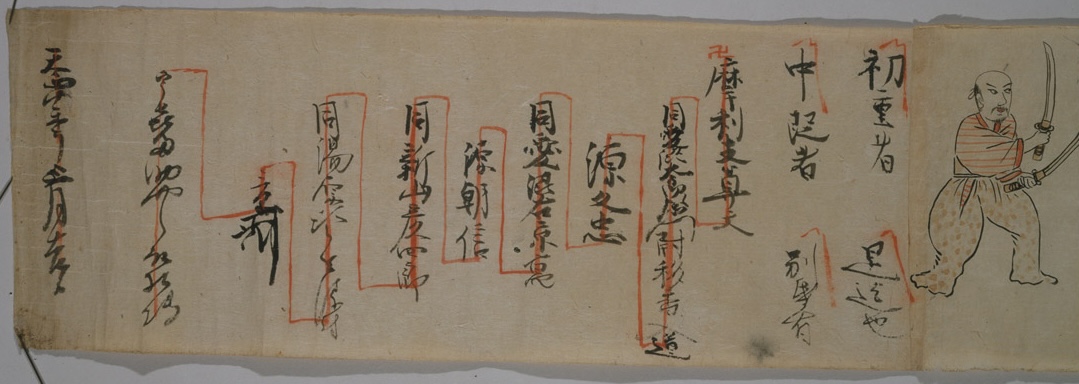
The surviving document: opening and closing portions
The two images below show the opening and closing portions of the surviving document discussed here. They precede the chapter's separate treatment of documentary wording and the limits of interpretation.
Documentary wording
The name found in the document
In the transmission diagram of the 1582 copy of 愛洲陰之流目録, a person is recorded as 愛洲太郎右衛門移香入道. Beside it is a notation that can be read as 源久忠.
The entry is considered likely to correspond to the person later commonly called 愛洲移香斎久忠. The forms visible in this document, however, are 愛洲太郎右衛門移香入道 and 源久忠; the exact continuous string 愛洲移香斎久忠 is not written there.
Tradition, research, and bibliography
愛洲移香 and 愛洲移香斎久忠
Later histories of martial arts and sword traditions have treated 愛洲移香 as an important figure associated with Kage-ryu. Modern publications also use forms such as 愛洲移香斎 and 愛洲移香斎久忠, but these should be kept distinct from the names recorded in the surviving documents.
The National Diet Library bibliographic record for 中世古祥道's 増補 愛洲移香斎久忠傳考 is organized under the subject heading 愛洲, 移香, 1452-1538. This is bibliographic authority information, and the book's full text has not been examined. However, no primary source establishing these life dates has been confirmed so far.
The Hirasawa family record titled 平沢家傳記 (internally titled 平澤氏家傳) is identified as having been compiled in Genroku 9 (1696) by the ninth-generation Hirasawa Michiari (通有). It preserves a family biographical account giving Hisatada’s birth in Kyōtoku 1 (1452), his death in Tenbun 7 (1538) at age 87, and his posthumous name as 移香. However, portions of the transmitted Hirasawa family documents were later lost or dispersed under wartime circumstances including air raids and during the confusion of repatriation from Manchuria, and the surviving original texts recorded there have not been available for direct examination.
The site retains 愛洲移香, confirmed in the Fukuoka City Museum material, as the displayed name in the transmitted lineage and examines 移香, 移香斎, and 久忠 source by source.
Evidence and reading
The early transmission diagram
In the same 1582 diagram, lines are drawn from 摩利支尊天 through several individuals. No notation identifies these connections as biological relations; the diagram is read here as a transmission or genealogical chart. In that diagram, the character following 愛洲右京 remained indistinct, with a notation reading 源朝信 beside it, leading onward to 湯原.
Meanwhile, transmission material dating to Tenshō 4 (1576) preserves the sequence from 摩利支尊天 through 愛洲太郎左衛門移香入道源久忠 and 愛洲右京亮源朝信 to 新原二次郎兵衛尉藤原雅景 and 湯原次郎兵衛尉雅景. This provides a fuller identification of the previously uncertain figure as 愛洲右京亮源朝信 and clarifies the subsequent names in that lineage. It also records a variant in Hisatada’s common name: 太郎左衛門 in the 1576 material, contrasting with 太郎右衛門 in the 1582 scroll.
Crucially, 愛洲右京亮源朝信 must not be identified with 愛洲小七郎宗通, known from later lineages and Hirasawa family tradition. No surviving source establishes that they are the same person or defines a family relationship between them; different transmission materials preserve different Aisu names and lineages, and their relationship remains an unresolved historical problem.
- 摩利支尊天
- 愛洲太郎左衛門移香入道源久忠
- 愛洲右京亮源朝信
- 新原二次郎兵衛尉藤原雅景
- 湯原次郎兵衛尉雅景
Later transmitted lineage
The later Hikita-den lineage
The lineage transmitted in Shinkage-ryu Hikita-den and the confirmed lineage section of 新陰流形組絵図 at Fukuoka City Museum show the sequence 愛洲移香, 愛洲小七郎, 上泉武蔵守, and 疋田栖雲斎. A lineage reproduced in modern scholarship records 疋田豊五郎 in the fourth position. The wording of each source is displayed separately.
Nor is this later lineage collapsed into the transmission sequence running from 摩利支尊天 through 愛洲太郎左衛門移香入道源久忠, 愛洲右京亮源朝信, 新原雅景, and 湯原雅景. Identifying figures between the two traditions—including the relationship between 愛洲右京亮源朝信 and 愛洲小七郎宗通—requires further documentary evidence.
Lineage wording in the published material
- 愛洲移香
- 愛洲小七郎
- 上泉武蔵守
- 疋田豊五郎
Checked wording in the Fukuoka City Museum material
- 愛洲移香
- 愛洲小七郎
- 上泉武蔵守
- 疋田栖雲斎
The written forms from the two sources are shown separately and retained as they appear in each source.
Source images
Empi — names visible in the source
Eleven names can be followed in sequence in the surviving illustrations. Here, they are presented as written in the diagram.
The first character of item nine is confirmed as 陰, so the name is read as 陰剣. How the nine illustrations described by Miyamoto and Uozumi correspond to the eleven visible names remains unresolved.
- 01猿飛Empi
- 02猿廻Enkai
- 03山陰Yamakage
- 04月影Tsukikage
- 05浮舟Ukifune
- 06浦波Uranami
- 07獅子奮迅
- 08山霞
- 09陰剣
- 10晴眼
- 11五月雨
Documented comparison
Comparison with Hikita-den
The first six entries in the surviving Kage-ryu sequence and the six entries transmitted in Hikita-den correspond in both name and order.
The Kage-ryu column continues for five further entries, while the Hikita-den sequence compared here ends with 浦波.
- 猿飛猿飛
- 猿廻猿廻
- 山陰山陰
- 月影月影
- 浮舟浮舟
- 浦波浦波
- 獅子奮迅—
- 山霞—
- 陰剣—
- 晴眼—
- 五月雨—
Scholarly interpretation
“Kage-ryu no mokuroku” in the Jixiao Xinshu
Miyamoto and Uozumi point out that two written passages in the first scroll correspond in content to the text preserved as 影流之目録 in 紀効新書 (Jixiao Xinshu).
This is an attributed scholarly finding about corresponding passages.
Hirasawa tradition and document records
“Hirasawa-ke Denki,” “Sangaku no maki,” and twelve technique names
The compilation 『平沢家傳記』 (Hirasawa-ke Denki, internally titled 平澤氏家傳) is identified as having been compiled in Genroku 9 (1696) by ninth-generation Hirasawa Michiari (通有). In the inventory of family-held scrolls recorded in the book, seventeen scrolls are listed under “Mokuroku jūyūnanajiku” (目録十有七軸), with an independent volume titled 『參學巻』 (Sangaku no maki) recorded as one of them. This establishes that a document identified as “Sangaku no maki / 參學巻” was recorded among the Hirasawa family’s transmitted documents by the time represented by the 1696 compilation.
However, the surviving original 『參學巻』 has not been available for direct examination, and its present whereabouts are unconfirmed. Consequently, the concrete contents and technical descriptions it may have contained cannot be determined from surviving evidence.
Regarding the ancient documents transmitted in the Hirasawa family, it is reported that portions of the collection were dispersed in later times or lost during the confusion of wartime air raids and repatriation from Manchuria. This provides the context for why the recorded original scrolls cannot be directly examined today.
Separately, material discussed in connection with the Aisu / Hirasawa tradition preserves twelve Kage-ryu technique names: 猿飛 (Sarutobi), 猿回 (Enkai), 山影 (Yamakage), 月影 (Tsukikage), 浮船 (Ukifune), 浦波 (Uranami), 覧行 (Rankō), 松風 (Matsukaze), 花車 (Hanaguruma), 長短 (Chōtan), 徹底 (Tettei), and 礒波 (Isonami). Here, source-specific orthography—such as 山影 (not 山陰), 猿回 (not 猿廻), 浮船 (not 浮舟), and 長短 (not 長短一味)—is strictly preserved.
Comparing the five techniques 覧行, 松風, 花車, 長短, and 徹底 with the five forms transmitted as “参学” in later Shinkage-ryu Hikita-den: of the five, four forms—覧行, 松風, 花車, and 徹底—bear identical names, while only 長短 is recorded as 長短一味 in Hikita-den. However, this remains circumstantial comparative evidence.
The Hirasawa family record documents the existence of a scroll titled 參學巻, while material associated with the Aisu/Hirasawa Kage-ryu tradition separately preserves the technique names 覧行, 松風, 花車, 長短, and 徹底. In the Hikita lineage, five forms are transmitted as “参学”, sharing four identical names alongside 長短一味. Whether the five techniques constituted the contents of the Hirasawa 參學巻 cannot presently be established from the surviving evidence.
- 01猿飛Sarutobi
- 02猿回Enkai
- 03山影Yamakage
- 04月影Tsukikage
- 05浮船Ukifune
- 06浦波Uranami
- 07覧行Rankō
- 08松風Matsukaze
- 09花車Hanaguruma
- 10長短Chōtan
- 11徹底Tettei
- 12礒波Isonami
Transmission and next chapter
Toward 愛洲小七郎 and 上泉武蔵守
The Hikita-den transmitted lineage later records the sequence 愛洲移香, 愛洲小七郎, 上泉武蔵守, and 疋田豊五郎. The transmission lines in Kage-ryu documents and the lineages preserved in later Shinkage-ryu and Hikita-den traditions do not necessarily coincide in personal names or lineages.
Accordingly, this chapter does not identify 愛洲右京亮源朝信, confirmed in the 1576 material, with 愛洲小七郎宗通 in the later lineage.
Conclusion
From the surviving documents to Kamiizumi Musashi-no-kami
Beginning with the surviving Kage-ryu documents, the 1582 scroll preserves the names 愛洲太郎右衛門移香入道 and 源久忠 alongside eleven names beginning with 猿飛. The 1576 transmission material confirms a line passing through 愛洲右京亮源朝信, while the 1696 Hirasawa record documents the existence of an independent 參學巻 alongside twelve technique names including 覧行 and 松風.
Yet the historical relationship between 愛洲右京亮源朝信 and the later lineage’s 愛洲小七郎宗通, as well as whether the five techniques preserved as 参学 in the Hikita transmission constituted the contents of the recorded 參學巻, cannot be hastily settled from surviving evidence.
Tracing the documentary evidence of Kage-ryu thus brings us, with its distinct source layers preserved, to the question leading toward Kamiizumi Musashi-no-kami. Chapter 2 follows him through contemporary records.
Sources
Primary material and research
Primary material
Tokyo National Museum — QA-3997
- 『愛洲陰之流目録』 — copy dated Tenshō 10 (1582)
- 『[愛洲陰流秘伝書]』 — copy dated Tenshō 4 (1576)
- 『仕相之太刀』 — dated Tenshō 4 (1576)
- 『目かくし』 — copy attributed to the Muromachi period
- 『新当りう奥三ッ太刀』 — dated Tenbun 17 (1548)
Research
『愛洲陰之流目録』(東京国立博物館蔵)の調査報告―新陰流との関係及び『紀效新書』所載の「影流之目録」についての新知見― — 宮本光輝・魚住孝至
Findings drawn from the paper are explicitly attributed to Miyamoto and Uozumi in the chapter.
新陰流(疋田伝)の研究 — 赤羽根龍夫・赤羽根大介 · Bulletin of Liberal Arts and Science 25, pp. 1–118; DOI 10.18924/00000388
Related sources
- 『紀効新書』「影流之目録」 — comparative text discussed by Miyamoto and Uozumi
- 新陰流形組絵図 — existing registered source
Research status
Current scope and next research
Reviewed material currently comprises the surviving Tokyo National Museum documents and catalogue, transmission records from the 1576 material, the published lineage section of the Fukuoka City Museum source, National Diet Library bibliographic information for 中世古祥道’s work, and published scholarly reports on Hirasawa family documents (including 平沢家傳記). The depth of review differs by source and is stated below.
No biographical facts are supplied from unexamined texts. The life of 愛洲移香, the relationship between 愛洲右京亮源朝信 and 愛洲小七郎宗通, the unconfirmed contents of the recorded 參學巻, and any specific instruction of 上泉武蔵守 remain unresolved. Future updates will continue to distinguish primary evidence, later tradition, bibliography, modern scholarship, and interpretation.
Reviewed
“Reviewed” means only the scope stated on each card; it does not imply examination of the complete text.
Registered source · confirmed transcription
新陰流形組絵図
- Reviewed scope
- The written form 愛洲移香 and the four-name sequence
This review is limited to the published lineage section and does not establish all relationships in the complete scroll.
Public catalogue information reviewed · detailed contents not examined
愛洲陰流伝書・新当流奥三ッ太刀
- Institution
- Tokyo National Museum
- Catalogue date
- Muromachi period; 16th-century copy
Title, institution, period, and copy date reviewed from public catalogue information; detailed contents not yet examined.
Bibliographic information reviewed · full text not examined
増補 愛洲移香斎久忠傳考
- Author
- 中世古祥道
- Institution
- National Diet Library
- Subject heading
- 愛洲, 移香, 1452-1538
Bibliographic data and subject heading reviewed; full text not examined, and the dates in the subject heading are not treated as established life dates.
Existence/location information reviewed · full text not examined
平澤家伝記
- Author
- 平沢通有
- Catalogue date
- compiled Genroku 9 (1696)
A family record compiled in Genroku 9 (1696) by ninth-generation Hirasawa Michiari. Its seventeen-scroll inventory records 參學巻. Later dispersal of transmitted documents is reported, and the scroll has not been available for direct examination.
Existence/location information reviewed · full text not examined
平沢氏家伝
- Author
- 平沢通有
- Catalogue date
- compiled Genroku 9 (1696)
Internal title or alternate designation for 平澤家傳記, recording the history of Hisatada, Munemichi, and subsequent generations alongside an inventory of transmitted documents.
Unresolved questions
Relationships among the names, the life of 愛洲移香, the relationship between 愛洲右京亮源朝信 and 愛洲小七郎宗通, identifications across the two lineage layers, the contents of the recorded 參學巻, and specific kinship, teaching, or direct transmission remain unresolved.
Full text not examined · sources for next research
- 平澤家伝記full text
- 平沢氏家伝full text
- 中世古祥道『増補 愛洲移香斎久忠傳考』full text
- 東京国立博物館所蔵『愛洲陰流伝書・新当流奥三ッ太刀』detailed contents
- 愛洲移香・愛洲小七郎・上泉武蔵守の関係を示す他の一次・近世史料location, full text, and relevant passages