History · Chapter 3
Chapter 3 | Hikita Bungorō — A Successor Emerging from the Documentary Gap
We do not begin by identifying Hikita as Kamiizumi Nobutsuna's disciple. We follow the documentary trail surrounding Hikita himself, and that trail eventually reaches Kamiizumi Musashi-no-kami and Fujiwara Nobutsuna ason.
Chapter 2 reconstructed the Kyoto activity of 上泉武藏守信綱 and his connections with 千秋刑部少輔, 鈴木, 山科言継, and others, chiefly through Tokitsugukyōki. Yet searches within the examined Tokitsugukyōki material for 疋田, 匹田, 曳田, 引田, 豊五郎, and 文五郎 did not identify Hikita Bungorō.
That is a documentary gap. Where, then, does Hikita first become visible in the documents? This chapter begins not with a later biography but with records directly connected with Hikita.
From Chapter 2
Where is Hikita Bungorō?
Kamiizumi and identifiable people around him appear in the Kyoto sources, but Hikita cannot be securely identified in the present search range. Then, in which surviving source does Hikita Bungorō first appear?
1566 · 新當流
侏田豊五郎 and 新當流
A document generally called 新當流兵法起請文 or 新当流兵法伝授起請文 survives in a public reproduction/transcription reporting 上野之住, 侏田豊五郎, 永祿九年二月晦日, and 雲林院弥四郎入道殿. It corresponds to the oath dated the last day of the second month in Mie-ken shi: shiryō-hen chūsei 3 (vol. 2), pp.469–470.
The same volume contains a separate oath dated the tenth day of the third month. The date 10 March 1566 in the Mie Prefecture historical article refers to that second document, not to a conflicting date for the first. The Iwao documents recorded by Mie-ken shi as 個人所蔵・調査 and the nineteen Iwao/Unrin-in family documents held by Kumamoto Prefectural Library have not been established as the same holding group. The present owner, location, and provenance of the two oaths remain unverified.
- Primary source
- Mie-ken shi: shiryō-hen chūsei 3 (vol. 2), pp.469–470; Mie Prefecture historical article; direct reply from Kumamoto Prefectural Library
- Documentary wording
- Last day of the second month: 上野之住/侏田豊五郎/雲林院弥四郎入道殿; tenth day of the third month: 侏田豊五郎/雲林院弥四郎入道殿.
- Modern rendering
- Two 新當流-related oaths transmitted as having been issued by 侏田豊五郎景兼 to 雲林院弥四郎入道.
- Reading
- A figure later associated with Shinkage-ryu appears here in a 新當流 transmission context. Why remains an open question.
- Reservation
- The present owner, location, and provenance of the two documents remain unverified. 上野之住 does not establish residence with Kamiizumi, travel with him, or a teacher–student relationship in 1566.
1566 · Ise
Two oaths from Eiroku 9 (1566) indicating activity in Ise province
Two kishobun (oaths of pledge) from Eiroku 9 (1566) survive, addressed by 疋田豊五郎景兼 (Hikita Bungorō Kagekane) to 雲林院弥四郎入道 of Ise province (present-day Mie Prefecture). The Iwao documents (岩尾文書) collected in Mie-ken shi: shiryō-hen chūsei 3 (vol. 2) include two “侏田景兼起請文” dated the last day of the second month and the tenth of the third month of the same year.
The oath dated the last day of the second month is titled “新当流兵法諸具足起請文” (oath concerning the implements of the Shintō-ryū way of strategy). Kagekane pledges not to disobey commands, not to associate this teaching with another school, and not to take disciples without his teacher's permission. Its signature reads:
上野之住侏田豊五郎景兼(花押)The notation “上野之住” (resident of Ueno) shows that, at least by the last day of the second month of Eiroku 9, Kagekane himself referred to Ueno province (Kozuke, present-day Gunma Prefecture) as his residence.
Kagekane is said to be the son of a sister of Kamiizumi Nobutsuna, and Nobutsuna's own base lay in Ueno province, Seta district, Kamiizumi village (around present-day Kamiizumi-chō, Maebashi). That Kagekane himself wrote “上野之住” is of interest when considering the relationship between the two.
On the tenth of the third month of the same year, Kagekane presented another kishobun to the same 雲林院弥四郎入道. This document is missing its beginning, but the surviving portion contains:
一、於此一太刀別流不可相交事一、伊勢国中之人ニ伝申間敷事一、太刀印可ぉ態望輩候者、一文之外出申間敷之事The passage concerns 一太刀, prohibits association with another school and transmission to people of Ise province, and addresses people seeking inka (印可). The expression 一文之外 is retained as written because its precise sense is not resolved here.
Following this,
十文字鑓・薙刀之向上之手一つ、此国中ニ而相伝申間敷事is also recorded, showing that transmission of the jūmonji-yari (十文字鑓) and naginata was likewise restricted within Ise province.
That the two kishobun were presented to the same 雲林院弥四郎入道 within roughly ten days shows that Kagekane and the Unrin'in stood in a concrete relationship over the transmission of the martial art at this time. What that relationship specifically was, and in what capacity Kagekane presented these oaths, cannot be determined from the two documents alone.
The word 態望 in the tenth-of-March kishobun is here taken to mean “to seek after.” In a later usage, the Iitaka family documents of Tenmei 7 (1787) have:
我等倅政四郎儀御態望に付き御養子に指し遺わし候処where it is used in the sense of “hope, request.” Since this is more than two hundred years later than Kagekane's kishobun, it is offered only as a reference example for the meaning of 態望.
The two kishobun are transcribed in Mie-ken shi: shiryō-hen chūsei 3 (vol. 2), pp.469–470. The source-location information in the same volume records the Iwao documents as “privately held; surveyed” (個人所蔵・調査). These Iwao documents and the nineteen Iwao/Unrin-in family documents held by Kumamoto Prefectural Library have not been established as the same holding group. The present owner, location, and provenance of the two oaths remain unverified.
Historical transcriptions
新当流兵法諸具足起請文一、御命不可相背之事一、此手別流不可相交之事一、為無師許弟子不可取之事若此条旨相背候者永禄九寅丙年二月晦日上野之住侏田豊五郎景兼(花押)雲林院弥四郎入道殿 参御宿所二紙目:新当流兵法起請文上者梵天、帝釈・四大天皇、殊ニ者王城之鎮守八幡大菩薩・摩利支天・鹿嶋・香取・愛宕地蔵大菩薩・氏神少も於偽御罰深可蒙者也、仍而起請文如件上野之住侏田豊五郎景兼(花押)永禄九年二月晦日雲林院弥四郎入道殿 参御宿所注:本文書の二紙目は、熊野牛玉宝印の裏面に書かれている。
(前欠)一、於此一太刀別流不可相交事一、伊勢国中之人ニ伝申間敷事一、太刀印可ぉ態望輩候者、一文之外出申間敷之事、付、十文字鑓・薙刀之向上之手一つ、此国中ニ而相伝申間敷事若此旨相背候ハ、此起請文深厚ニ可蒙者也、仍起請文如件永禄九寅丙年三月十日侏田豊五郎景兼(花押)雲林院弥四郎入道殿 参人々御中二紙目:上者梵天・帝釈天・四大天皇・殊者王城之鎮守八幡大菩薩・摩利支尊天・鹿嶋・香取・愛宕地蔵大菩薩・氏神少も於偽御罰深可蒙者也侏田豊五郎景兼(花押)永禄九寅年三月十日雲林院弥四郎入道殿 参人御中注:本文書の二紙目は、熊野牛玉宝印の裏面に書かれている。
Source: 『三重県史 資料編 中世3(下)』pp.469–470、「岩尾文書」
1577 · 正文
Oda Nobutada's oath
Hosokawa-ke monjo: Chūseihen, fig. 44, p. 203, document 174 (Nobutada 2). Folded sheet mounted as a scroll, 283 × 452 mm. Dated the intercalary seventh month, eleventh day, Tenshō 5; addressed to 侏田豊五郎殿. The edition commentary identifies it as 正文.
其方兵法新陰之流不残相伝祝着候、寄特無是非候、右之太刀之極意不可他言候、若此帋面於相違者、日本国中大小神祇可蒙罰者也、(天正五年)閏七月十一日信忠(花押)侏田豊五郎殿- Primary source
- Hosokawa-ke monjo: Chūseihen, fig. 44, document 174 (Nobutada 2)
- Documentary wording
- 其方兵法新陰之流不残相伝祝着候……右之太刀之極意不可他言候……侏田豊五郎殿
- Modern rendering
- Nobutada expresses satisfaction at having received the martial transmission called 新陰之流 without remainder, promises not to disclose the ultimate teaching of the sword, and invokes divine punishment for breach.
- Reading
- Strong evidence that by 1577 侏田豊五郎 functioned as a transmitter of a martial tradition explicitly written 新陰之流.
- Reservation
- The oath does not establish Hikita's birthplace, the circumstances or date of study with Kamiizumi, or the full later biography. The editors' 正文 classification does not by itself answer every handwriting or autograph question.
1589 · blood seal
Toyotomi Hidetsugu's blood-sealed oath
Hosokawa-ke monjo: Chūseihen, fig. 85, p. 249, document 215 (Hidetsugu 1). Vertical sheet mounted as a scroll, 310 × 500 mm. Dated the second month, twenty-third day, Tenshō 17. The edition's addressee form is retained exactly: 疋田分五郎とのへ.
敬白起請文之事一、新陰流不可交他流事、一、無許条始参学太刀不可有他見事、一、封師道不可有疎意事、右条々於偽者、梵天帝釈四大天王惣而日本国中大小神祇、殊ニハ八幡大菩薩各可蒙御罰者也、仍如件、天正拾七年二月廿三日秀次(花押・血判)疋田分五郎とのへ- Primary source
- Hosokawa-ke monjo: Chūseihen, fig. 85, document 215 (Hidetsugu 1)
- Documentary wording
- 新陰流不可交他流事/無許条始参学太刀不可有他見事/封師道不可有疎意事
- Modern rendering
- The oath prohibits mixing 新陰流 with another school, showing the initiating 参学太刀 without permission, and neglecting 師道; breach invokes punishment by the deities. It bears Hidetsugu's signature mark and blood seal.
- Reading
- The combination of 新陰流, 参学太刀, 師道, and secrecy provides a terminological bridge to the 1600 新陰流参学之目録.
- Reservation
- 参学太刀 remains visible as a technical expression. The transcription 封師道 is retained from the edition.
Documentary names
The many names in the sources
The record gives 侏田豊五郎 in 1577, 疋田分五郎 in 1589, 疋田文五郎とのへ in Tokugawa Hidetada's oath, 疋田豊五郎入道景兼 in 1600, and later 栖雲斎.
The spellings differ, but the dates and the context of transmission, together with names such as 景兼 and 栖雲斎, connect these records.
| Date | Documentary form | School form / term | Document |
|---|---|---|---|
| 1566 | 侏田豊五郎 | 新當流 | Two oaths addressed to Unrin-in Yashirō Nyūdō, dated the last day of the second month and the tenth day of the third month. Their present location is unverified. |
| 1577 | 侏田豊五郎 | 兵法新陰之流 | Oath of Oda Nobutada. |
| 1589 | 疋田分五郎 | 新陰流/参学太刀 | Blood-sealed oath of Toyotomi Hidetsugu. |
| Date not supplied | 疋田文五郎 | — | Addressee form in Tokugawa Hidetada's oath; this chapter does not supply an unverified date. |
| 1599 | 疋田景兼 | 新陰之流 | Document to Kuroda Nagamasa, held by Fukuoka City Museum. |
| 1600 | 疋田豊五郎入道景兼 | 新陰流 | Illustrated mokuroku to Nagaoka Yokurō. |
| Date not supplied | 藤原朝臣景兼/疋田豊五郎入道/栖雲斎 | 新陰流鑓目録 | Spear mokuroku addressed to Hosokawa Naiki. |
Scale of transmission
Nobutada, Hidetsugu, and Hidetada
Oaths survive involving Oda Nobutada, Toyotomi Hidetsugu, and Tokugawa Hidetada. The safe conclusion is that, by the late sixteenth century, high-ranking political and military figures issued secrecy or transmission oaths to Hikita.
The edition's phrase 天下人クラス is an editorial assessment, not wording in the documents. This chapter does not turn it into a romantic title such as “master of the three unifiers,” or import later duel stories.
1599 · Fukuoka
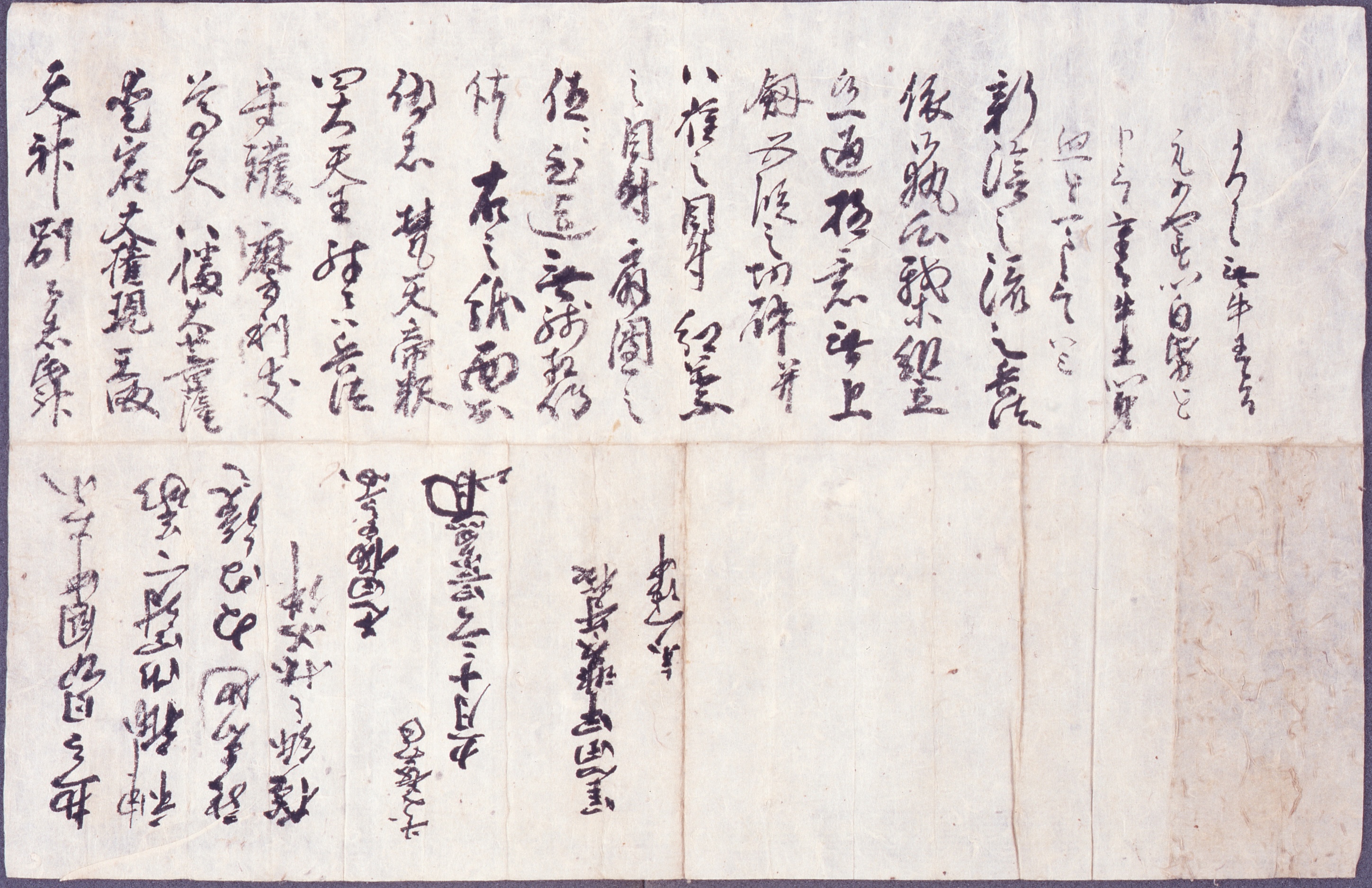
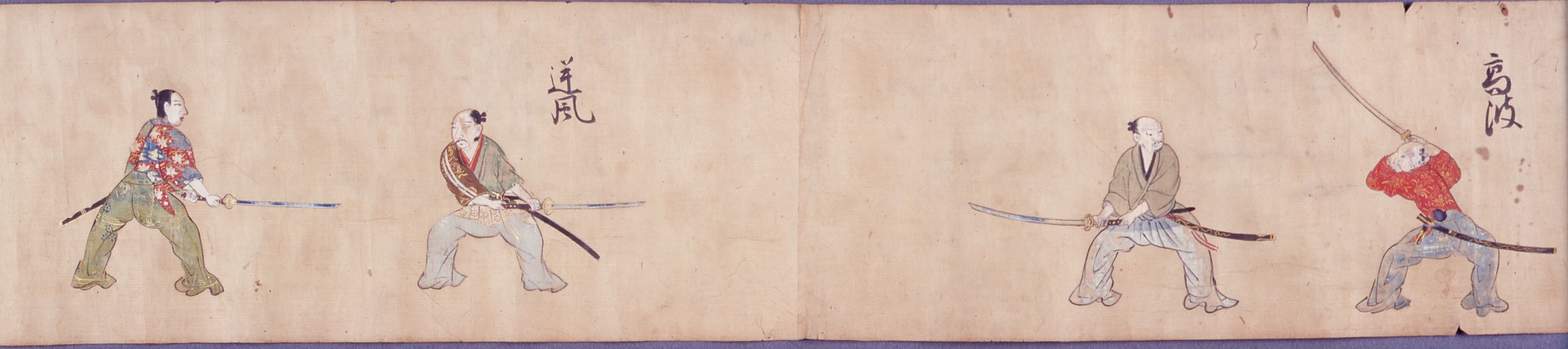
Hikita Kagekane to Kuroda Nagamasa
Fukuoka City Museum metadata identifies 疋田景兼 as issuer, 黒田長政 as recipient, and the fifth month of Keichō 4 (1599) as the date. Museum item 104; ink and colour on paper, handscroll, folded sheet, 31.9 × 48.8 cm. Its English catalogue title is Illustrated Scroll of the Shinkage School of Japanese Fencing.
The checked source image reads 新陰之流. Museum catalogue data for issuer, recipient, date, and holding is strong cataloguing evidence.
- Primary source
- Fukuoka City Museum catalogue record 104 and visually checked source image
- Documentary wording
- 疋田景兼/黒田長政/慶長4年5月/新陰之流
- Modern rendering
- A document directly connected with Kagekane's transmission activity, addressed to Kuroda Nagamasa, using the form 新陰之流.
- Reading
- Alongside a recipient's 1577 oath, this provides the issuing side of a Hikita-related transmission to a high-ranking figure in 1599.
- Reservation
- Catalogued issuance, recipient, and date remain distinct from the surviving object's originality, scribe, and autograph status. The museum's later biography is secondary.
Open provisional image at full size
Open provisional image at full size
Open provisional image at full size
1600 · illustrated mokuroku
Hikita Bungorō Nyūdō Kagekane to Nagaoka Yokurō
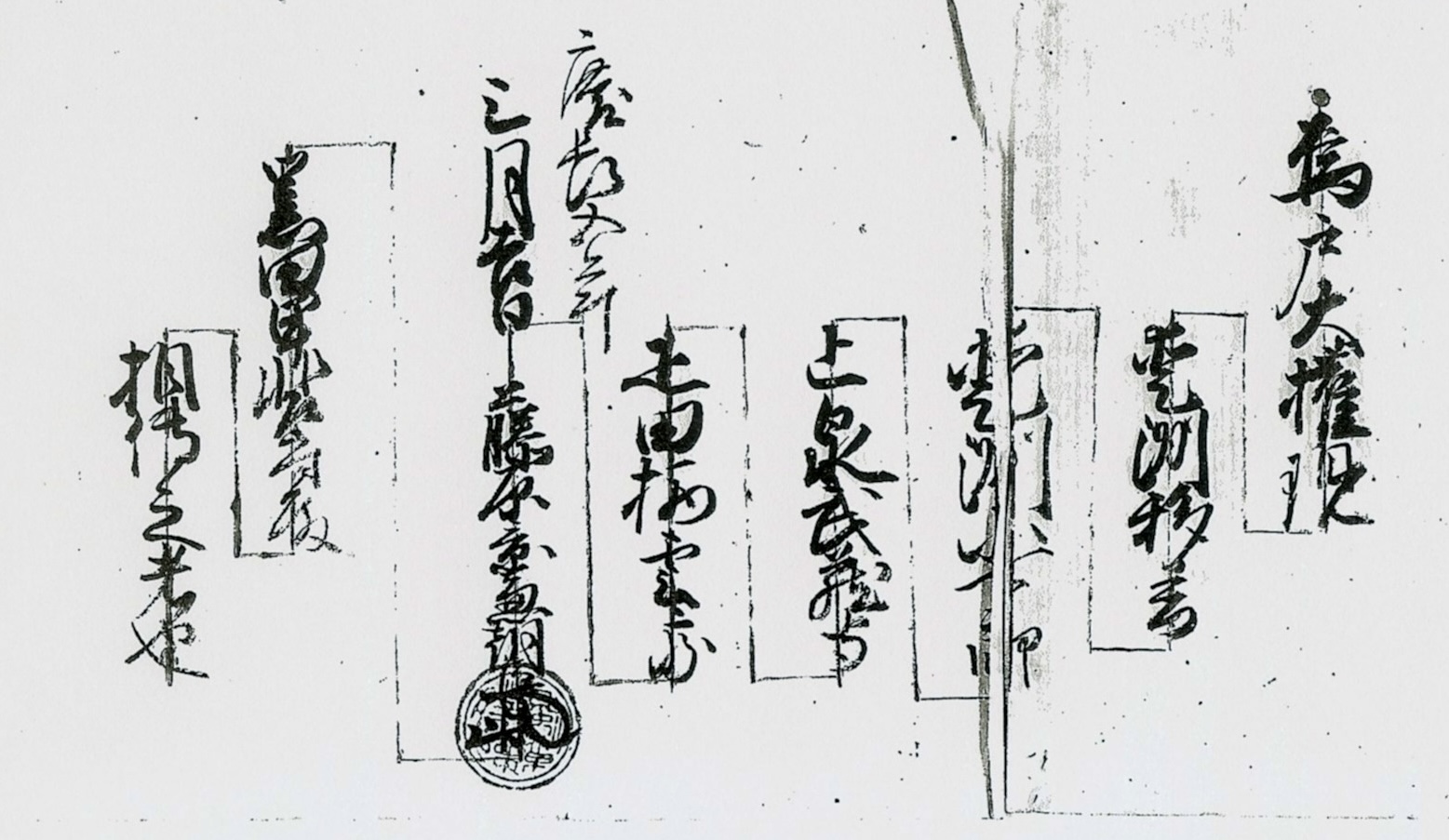
Hosokawa-ke monjo: Kojitsu / Bugeihen, fig. 95, 疋田豊五郎入道景兼新陰流兵法目録. Dated an auspicious day in the second month of Keichō 5 and addressed to 長岡与九郎. The editorial commentary describes an illustrated mokuroku of eighteen entries in three sections: 新陰流之猿飛之目録, 新陰流参学之目録, and 位詰之目録.
The colophon below is presented as a vertical transmission-genealogy structure, not a simple left-to-right sentence. Here the name 藤原信綱朝臣, as written in the document, is given as it stands.
- 鵜戸大権現
- 愛洲移香
- 愛洲小七郎
- 藤原信綱朝臣
- 上泉武蔵守
- 疋田豊五郎入道
- 慶長五年/二月吉日
- 長岡与九郎殿江
- 景兼(花押・印)/相伝之
The vertical arrangement is not flattened into a sentence or a chain of direct personal instruction.
- Primary source
- Hosokawa-ke monjo: Kojitsu / Bugeihen, fig. 95
- Documentary wording
- 藤原信綱朝臣/上泉武蔵守/疋田豊五郎入道/景兼(花押・印)相伝之
- Modern rendering
- The transmission genealogy places Fujiwara Nobutsuna ason, Kamiizumi Musashi-no-kami, and Hikita Bungorō Nyūdō within one structure, with Kagekane's signature mark and seal in the record of transmission to Nagaoka Yokurō.
- Reading
- The document directly connects 疋田豊五郎入道 with 景兼 and carries the Hikita-side transmission genealogy back to 上泉武蔵守 and 藤原信綱朝臣.
- Reservation
- The vertical layout is not flattened into a sentence or assumed to mean direct personal instruction at every step. Transmission authority, originality of the surviving object, and handwriting or autograph status are separate questions.
Written-form comparison
新陰之流 and 新陰流
Both forms are attested in documentary contexts directly connected with Hikita's transmission activity. The 1599 and 1600 documents are especially significant: only about nine months apart, both concern Kagekane transmitting martial material.
The presence or absence of 之 therefore cannot serve by itself as a test of authenticity. Ordinary grammar, document style, scribal practice, different writers, or the degree to which the school name had become lexicalised remain hypotheses; the evidence does not select one.
| Date | Documentary relationship | Source form | Document type |
|---|---|---|---|
| 1577 | 織田信忠 → 侏田豊五郎 | 兵法新陰之流 | 起請文 |
| 1589 | 豊臣秀次 → 疋田分五郎 | 新陰流 | 血判起請文/参学太刀 |
| 1599 | 疋田景兼 → 黒田長政 | 新陰之流 | 福岡市博物館所蔵資料 |
| 1600 | 疋田豊五郎入道景兼 → 長岡与九郎 | 新陰流 | 猿飛・参学・位詰の絵目録 |
Terminological continuity
参学 — from 1589 to 1600
The 1589 oath contains 参学太刀; the 1600 illustrated mokuroku contains 新陰流参学之目録. The appearance of 参学 across Hikita's transmission context strongly suggests continuity in terminology.
Back to Chapter 1
猿飛 — a connection to the Aisu material
The 1600 新陰流之猿飛之目録 creates an explicit comparison with the 猿飛 material in Aisu and Kage-ryū-related documents examined in Chapter 1.
The shared name matters, but does not automatically establish identical technical content or unchanged bodily practice. Names, sequence, illustrations, and explanatory text are compared only where each document permits.
Methodological arrival
Hikita's documents reach Kamiizumi
This chapter did not begin by assuming that Hikita was Kamiizumi's disciple. Following Hikita-related documents led to a 1600 transmission record that itself reaches 藤原信綱朝臣 and 上泉武蔵守.
Chapter 2 independently found 上泉武藏守信綱 in Tokitsugukyōki and, through published scholarship, 上野國上泉住、大胡武藏守 藤信綱 in Rekimei dodai. Read together, a relatively early Hikita-side transmission document points to the same Kamiizumi Musashi-no-kami / Nobutsuna. This is the point reached by following one document to another.
One colophon
景兼, 豊五郎, and 栖雲斎
Fig. 96 in Hosokawa-ke monjo: Kojitsu / Bugeihen, 疋田豊五郎入道栖雲斎新陰流鑓目録, connects 藤原朝臣景兼, 疋田豊五郎入道, and 栖雲斎 within one colophon. That is stronger evidence for the relationship among the names than reliance on later biography alone.
The addressee is 細川内記殿. The edition commentary identifies him as Hosokawa Tadatoshi; the text does not literally say 忠利, so that identification remains editorial.
- 鵜戸大権現
- 愛洲移香
- 同小七郎
- 藤原信綱朝臣
- 上泉武蔵守
- 藤原朝臣景兼
- 疋田豊五郎入道
- 栖雲斎(花押・印)
- 進上/細川内記殿/参
The vertical arrangement is not flattened into a sentence or a chain of direct personal instruction.
- Primary source
- Hosokawa-ke monjo: Kojitsu / Bugeihen, fig. 96
- Documentary wording
- 藤原朝臣景兼/疋田豊五郎入道/栖雲斎(花押・印)/進上 細川内記殿 参
- Modern rendering
- One colophon places Kagekane, Hikita Bungorō Nyūdō, and Seiun-sai in sequence and presents the document to Hosokawa Naiki.
- Reading
- Direct documentary evidence of high relevance for relating the personal name, common name, and retirement or Buddhist name.
- Reservation
- 細川内記 as Hosokawa Tadatoshi is the editors' identification, not literal text. A signature mark and seal do not establish that Hikita personally wrote every character.
Range of 兵法
The 新陰流鑓目録
Its inner title is 上下之鎗合 口伝. The edition describes nine spear items and explains the absence of written 遣方 instructions as a consequence of oral transmission. The latter is editorial commentary, not wording in the source.
Hikita's activity should not be reduced to the modern category “swordsmanship.” The documents use 兵法, 新陰流, 太刀, 参学, 猿飛, 位詰, and 鑓, indicating a wider martial transmission context.
Later copy
Read 廻国記 later, not first
Only after reconstructing the contemporary and early-modern Hikita documents do we turn to 疋田豊五郎入道栖雲斎廻国記. The accessible text belongs to a later copy tradition; it is not treated as a contemporary Hikita autograph.
Claims about service to Hosokawa Fujitaka, travel, twenty-four matches and victories, return to Buzen, service under Hosokawa Tadaoki, stipends, and related details are not upgraded to established fact without checking the copy lineage, an original, and external sources. They are compared against the documentary chronology already established.
A
Contemporary / early-modern document
Read issuance, addressee, date, text, and colophon only to the extent checked.C
Later copy / tradition
Biographical claims are not made contemporary fact without checking copy lineage and external records.Higo memory
How Wada Kiden remembered Hikita
The lineage in Higo budōshi ends with 和田喜傳高安. Wada Kiden wrote 傳書より見たる劍道新陰流, first serialised in a newspaper around Shōwa 8 (1933). Material for the 1931 imperial martial demonstration records 新陰流, uchidachi 和田喜傳, and shidachi 古賀榮信.
Wada can therefore be presented as a modern Higo Shinkage-ryū practitioner-transmitter whose writings show how Hikita was remembered and interpreted through family tradition and transmission documents.
Part II
Later transmission, family history, and unresolved questionsRead as a layer distinct from the documentary chronology reconstructed in Part I. Later scholarship, Hikita family tradition, and present-day events are not projected back as sixteenth-century fact.A / C — Transmitted lineage
Position in the transmitted lineage
In the lineage transmitted within Shinkage-ryu Hikita-den, 疋田栖雲斎 stands between 上泉武蔵守 and 上野左右馬助景用. The confirmed portion of 新陰流形組絵図, held by Fukuoka City Museum, likewise records 愛洲移香, 愛洲小七郎, 上泉武蔵守, and 疋田栖雲斎 in that order.
This site uses 疋田栖雲斎, the form written in that source, as the name in the transmitted lineage. The forms treated in Part I — 侏田豊五郎, 疋田分五郎, 疋田文五郎, and 疋田豊五郎入道景兼 — remain documentary wording belonging to Part I. Names in the lineage are shown as they are written in the documents.
C / G — Later source, unverified
Name forms appearing in later tradition
In a 1938 Weekly Asahi article, the speaker identified only as Wada mainly uses 疋田文五郎 and discusses 文五郎/豊五郎 and the written form 引田. This is twentieth-century recollection, not direct evidence of a sixteenth-century name, and is kept in a layer separate from the documentary forms treated in Part I.
匹田 and 曳田 remain search variants. 引田 is a written form appearing in the 1938 article. It is kept separate from the names confirmed in documents connected to Bungoro himself.
C / G — Later copy, unverified
What cannot be established about the teacher–student relationship
廻国記 presents Bungoro as its narrator and as a student of 上泉武蔵守. Even read together with the 1600 transmission document in Part I, which reaches 上泉武蔵守 and 藤原信綱朝臣, the evidence does not establish the year they first met, the place of instruction, or the scope of transmission.
Narratives of transmission at about age twenty-seven, departure on musha-shugyo, or an instruction to spread a “Hikita school” cannot be established from the source text currently reviewed. Nor does this evidence settle rank or personal relationships among Bungoro, Yagyu Munetoshi, and Marume Kurando. What it does preserve is a Hikita transmission route recorded as running from Kamiizumi to Bungoro without passing through the Yagyu house.
Sources and references新陰流形組絵図Keichō 5 Shinkage-ryu transmission document associated with 疋田豊五郎入道景兼廻国記新陰流(疋田伝)の研究
E / F / G — Scholarship, family tradition, unverified
Traditions of origin and kinship
The documents in Part I show Hikita's transmission activity but say nothing about his birthplace or kinship. What follows belongs to later scholarship and Hikita family tradition, and is not folded into the Part I chronology as sixteenth-century fact.
E / F / G — Scholarship, family tradition, unverified
Kaga, and Echizen/Tsuruga
A later tradition associates the Hikita family with Hikida village in Tsuruga district, Echizen. The repository does not yet contain the text or formation date of the source behind that claim, so it is listed only as a research lead.
Page 1 of 新陰流(疋田伝)の研究 describes Bungoro as born in Kaga, but no claim-specific primary-source note was found on the reviewed page. Hikita family tradition independently remembers a grandmother saying that Bungoro came from Kaga and that the family was connected to him. The present custodian also remembers seeing a related document and a very long genealogy scroll displayed annually in the tokonoma, but their current location is unknown. Because the date and contents of the document and scroll cannot be verified, a Kaga origin is not established. Neither the Echizen/Tsuruga account nor the Kaga tradition can yet be selected over the other.
E / F — Scholarship and family tradition
The tradition that he was Kamiizumi's nephew
Page 1 of the 2007 study presents Bungoro's mother as Kamiizumi Nobutsuna's elder sister, although the underlying source cannot be traced from the reviewed page. The Hikita family separately remembers Bungoro as the child of Kamiizumi's elder sister. The correspondence is historically interesting. The two traditions agree here. A contemporary source documenting the uncle-nephew relationship, however, has not yet been confirmed.
F — Hikita family tradition
The character 兼 in the Hikita family
Several later names in the privately held Hikita genealogy use 兼. The present custodian has never heard a tradition deriving this usage from Bungoro's 景兼. It is recorded only as an observation of unknown relationship. Personal names and images of the private genealogy are withheld at the family's request.
Sources and references新陰流(疋田伝)の研究Hikita family tradition identifying the family as a direct line of Hikita Kosanji (小三次 / 小三治)
C / G — Later copy, unverified
The itinerary and encounters in 廻国記
As stated in Part I, the accessible 廻国記 belongs to a later copy tradition, and the text consulted here is a Markdown working transcription used for project research. The original's location, provenance, date, autograph or copy status, copy lineage, transcription basis, editorial history, and character-level accuracy remain unverified. Even with those limits, it is the most concrete text now available for studying Bungoro as a travelling practitioner.
The table includes only places and events that can be taken cautiously from the working text. No route map is drawn at this stage, because uncertain sequence and missing intermediate routes would force unsupported connections. The close frames the record as written after a report and questioning, but does not prove direct commissioning by Hosokawa Tadaoki or official diary status.
The number of encounters also differs by source. Accounts depending on 廻国記 report twenty-four matches and victories, while in 1938 Wada recalled the number as “twenty-three or twenty-seven.” Both are later Higo-side accounts, and no records from the opponents corroborate individual outcomes. Neither is normalized into a story of twenty-five victories.
| Date | Place | People | Event | Source | Evidentiary status |
|---|---|---|---|---|---|
| Year unknown | Ise | Unidentified | Appears as a place in the working itinerary. | Kaikokuki working transcription | Original and external corroboration unverified |
| Year unknown | Yamashiro / Kyoto | Unidentified | Appears as a region in the working itinerary. | Kaikokuki working transcription | Original and external corroboration unverified |
| Year unknown | Iwatsuki, Musashi | Chikuma Rihei | An encounter invokes 猿飛, 三学, and 位詰. | Kaikokuki working transcription | Person and event externally unverified |
| Keicho 6 (1601), second month, day 15 | Buzen | Hikita Bungoro | The text records his return by boat. | Kaikokuki working transcription | Date in the transcription; landing place and external record unverified |
Sources and references廻国記『週刊朝日』昭和13年(1938年)6月26日号「古武道の真髄を語る」
A / C / E / G — Source, tradition, scholarship, unverified
Service under the Hosokawa house and conflicting stipends
For Oda Nobutada and Toyotomi Hidetsugu, Part I treats the oaths themselves through the plates and document numbers of Hosokawa-ke monjo: Chūseihen. Their connection with Hikita therefore rests on documents rather than on later claims.
What remains open concerns the Hosokawa house. The working 廻国記 contains 細川兵部太夫家中 and 忠興公, but the institutional meaning of 家中 and the details of appointment or holdings remain unresolved. For Hosokawa Fujitaka (Yusai), no source showing a relationship has yet been confirmed in the registered material.
The stipend figures differ by source. They are neither added together nor harmonized, and are presented as they stand.
| Person | Supported contact | Unresolved question | Evidence layer |
|---|---|---|---|
| Hosokawa Fujitaka (Yusai) | No direct statement in the registered material | Not inferred backward from references to Tadaoki | Unverified |
| Hosokawa Tadaoki (Sansai) | 細川兵部太夫家中 and 忠興公 in the working Kaikokuki | Institutional meaning, appointment, and holdings unresolved | Text of a later copy |
| Kuroda Nagamasa | 新陰流形組絵図 is addressed to Nagamasa (Part I, section 06) | An addressee does not establish pupil status or the circumstances of instruction | Early-modern source |
| Source | Claim | Treatment |
|---|---|---|
| Wada's 1938 account | 150 koku in Tango; resignation, tonsure, travel, and reunion in Kokura | Later Higo-side tradition |
| Kaikokuki working transcription | Wording concerning 200 koku, Usa district, and another 200 koku from Tadaoki | Syntax, institutional meaning, and relationship unresolved |
| Modern study, 2007, p. 10 | Service at 350 koku | No claim-specific primary-source note found on the reviewed page |
Sources and references廻国記新陰流(疋田伝)の研究『週刊朝日』昭和13年(1938年)6月26日号「古武道の真髄を語る」新陰流形組絵図
C / E / G — Tradition, scholarship, unverified
After Bungoro — martial transmission toward Higo
The current lineage and modern research place Ueno Somanosuke Kagemochi after Bungoro and continue through the Ueno and Wada houses. This is a lineage of martial transmission, not a biological genealogy. The working 廻国記 does not name Kagemochi, and no direct document giving the date, place, or content of instruction from Bungoro has been reviewed.
Wada's 1938 account says Bungoro did not marry and passed the tradition to 上野相馬之介. A separate claim of a child or successor named Katsushige lacks a verified source text in the repository. The two are not reconciled, and the family relationships remain unresolved. Martial succession and biological descent are distinct questions.
- Hikita Bungoro Kagekane
- Ueno Somanosuke Kagemochi
- Ueno house
- Wada house
Sources and references新陰流(疋田伝)の研究肥後細川藩―新陰之流伝書集『週刊朝日』昭和13年(1938年)6月26日号「古武道の真髄を語る」
A / F / G — Source, family tradition, unverified
The Hikita family in Chikuzen and the Fukuoka domain
According to current Hikita family tradition, the family descends directly from Hikita Kosanji (also written 小三治) and has preserved Bungoro's memory. This offers a route into the history of a Hikita family associated with Chikuzen, separate from the martial transmission toward Higo.
Reported wording in a Genna-period register concerning 折尾・疋田小三次 and 知行弐百石 cannot yet be published as an established quotation because the repository contains no verified text, bibliography, or page location. It is recorded as the next research item, to be checked against an original or a reliable transcription. The Higo martial route and the Chikuzen family route are not assumed to be identical.
The Fukuoka City Museum catalogue lists 疋田景兼 in the creator field for 新陰流形組絵図, and the scroll includes an address to Kuroda Nagamasa. This links a martial document associated with Hikita Kagekane to Nagamasa.
Family traditions about conflict with the Kuroda house, suppression or restoration of the family, and survival of the martial transmission through pupils require corroboration from public sources and confirmation of wording by the family. No private correspondence is quoted here, and unverified family tradition is not inserted into the historical narrative. Domain registers, genealogies, and administrative records remain to be examined first.
Sources and referencesHikita family tradition identifying the family as a direct line of Hikita Kosanji (小三次 / 小三治)新陰流形組絵図
F — Hikita family tradition
Bungoro-san in Hikita family memory
Within the Hikita family, Bungoro has been remembered as Bungoro-san rather than as a distant historical name. Family tradition says he was the child of Kamiizumi Nobutsuna's elder sister, came from Kaga, and was connected to the present family. The current custodian remembers seeing a document about that relationship and a very long genealogy scroll displayed in the tokonoma once a year.
The present locations of the document and scroll are unknown, and their contents and dates cannot be verified. Their value here is not to prove sixteenth-century origin or kinship, but to document how Bungoro has been remembered within the family. No identifying details of living people, private messages, genealogy images, or unpublished personal names are included.
Sources and referencesHikita family tradition identifying the family as a direct line of Hikita Kosanji (小三次 / 小三治)
B — Interpretation
Person, family, and martial tradition — three histories
The evidence is clearer when it is not folded into a single story but kept as three histories: Bungoro himself, recorded as travelling, meeting opponents, and teaching; the Hikita family, which preserved memories of him in association with Chikuzen; and the martial transmission of Shinkage-ryu, passed through students and later Higo houses independently of biological descent.
Compared with the relatively strong overlap of house and martial transmission visible in the Yagyu case, the Hikita individual, family, and martial routes can be interpreted as having diverged. The history of a person, a family, and a martial tradition are not the same.
Sources and references廻国記新陰流(疋田伝)の研究肥後細川藩―新陰之流伝書集Hikita family tradition identifying the family as a direct line of Hikita Kosanji (小三次 / 小三治)
H — Modern record
Two lines meet again in Kokura
Through an unexpected connection, in 2024 at Kokura Park, the current transmitter of Shinkage-ryu Hikita-den responsible for this website was able to pass on the 猿飛 (Empi) kata to a present-day descendant of the Hikita family.
Hikita Bungoro is remembered as having travelled and transmitted martial practice. The family that carried his name and the practitioners who carried the martial tradition had followed different paths for centuries. In Kokura, they met again. The histories of person, family, and martial transmission continue along their distinct paths in the present.
Sources and referencesHikita family tradition identifying the family as a direct line of Hikita Kosanji (小三次 / 小三治)
Conclusion
A genealogy reached by following the documents
Hikita Bungorō did not readily appear in the Kyoto sources surrounding Kamiizumi. Yet a chronological path through documents connected with Hikita gradually brings one martial transmitter into view behind the forms 侏田豊五郎, 疋田分五郎, 疋田文五郎, 疋田豊五郎入道景兼, and 栖雲斎.
In 1577, 新陰之流; in 1589, 新陰流 and 参学太刀; in 1599, 新陰之流; in 1600, 新陰流之猿飛之目録, 新陰流参学之目録, and 位詰之目録. The 1600 transmission genealogy itself joins 愛洲移香, 愛洲小七郎, 藤原信綱朝臣, 上泉武蔵守, and 疋田豊五郎入道景兼.
We did not search for Hikita Bungorō as “Kamiizumi Nobutsuna's disciple.” We followed the documents surrounding Hikita Bungorō, and they led us to Kamiizumi. Chapter 1's Aisu, Kage-ryū, and 猿飛 material, Chapter 2's contemporary Kamiizumi Musashi-no-kami Nobutsuna, and Chapter 3's Hikita transmission documents were examined independently; the surviving documents themselves now begin to connect them.
Part II then followed the histories of the individual, the family, and the martial tradition, tracing where they intersected and where they diverged. What the documents record, what remains later tradition, and what is still unknown are deliberately left distinct.
The next chapter will follow when its sources and scope can be verified; no content is anticipated here.
Sources
Sources and review scope
Issuance or transmission authority, originality of the surviving object, and handwriting or autograph status are separate; edition transcriptions and editorial commentary are also distinguished.
A — evidence layer
『三重県史 資料編 中世3(下)』
Pages 469–470 contain two 侏田景兼起請文, dated the last day of the second month and the tenth day of the third month of Eiroku 9. The source-location information records the Iwao documents as ‘privately held; surveyed’ (個人所蔵・調査), but this reflects the edition's information and does not establish their present owner, location, or provenance. This implementation uses the supplied transcription; a complete character-by-character comparison with images of those pages has not been performed.
A — evidence layer
熊本県立図書館からの回答
The library's Iwao/Unrin-in family collection comprises nineteen Shintō-ryū and Shinkage-ryū licences in four scrolls. The currently available evidence does not establish that either of the two 1566 oaths discussed here is among those holdings, or that the library collection is the same holding group as the Iwao documents recorded in Mie-ken shi as 個人所蔵・調査.
A — evidence layer
『細川家文書 中世編』
Fig. 44, p. 203, document 174 (Nobutada 2); fig. 85, p. 249, document 215 (Hidetsugu 1); commentary pp. 346–347.
A — evidence layer
福岡市博物館所蔵資料 104
Issued by 疋田景兼 to 黒田長政, fifth month of Keichō 4 (1599). Ink and colour on paper, handscroll, folded sheet, 31.9 × 48.8 cm. 新陰之流 has been visually checked in the source image. The three files displayed in the chapter are provisional, not the official museum color reproduction expected later.
A — evidence layer
『細川家文書 故実・武芸編』
Tokugawa Hidetada oath; fig. 95, 疋田豊五郎入道景兼新陰流兵法目録; fig. 96, 疋田豊五郎入道栖雲斎新陰流鑓目録. Edition transcriptions and editorial commentary are kept distinct.
C — evidence layer
『疋田豊五郎入道栖雲斎廻国記』
Available through a later-copy tradition; not treated as a contemporary Hikita autograph.
C — evidence layer
『肥後武道史』/和田喜傳「傳書より見たる劍道新陰流」
Wada Kiden's essay, first serialised in a newspaper around Shōwa 8 (1933); the displayed lineage ends with 和田喜傳高安.
A / C — evidence layer
昭和6年天覧武道大会関係資料
Records 新陰流, uchidachi 和田喜傳, and shidachi 古賀榮信. It documents modern practice, not sixteenth-century lineage claims.
Part II
Sources used in Part II
Each entry states the scope reviewed. Inclusion does not mean that the complete contents, provenance, or autograph status have been verified.
Textual source · reviewed form qualified
Keichō 5 Shinkage-ryu transmission document associated with 疋田豊五郎入道景兼
- Reviewed scope
- Supplied transcription reviewed · original source not examined
The supplied lineage notation in a Shinkage-ryu transmission document associated with 疋田豊五郎入道景兼 records 上泉武蔵守 and 藤原信綱朝臣. It is not a contemporary record from Kamiizumi's lifetime, but is treated as relatively early Hikita-line evidence for 信綱. The original's location, provenance, and complete text have not been verified.
Textual source · reviewed form qualified
廻国記
- Reviewed scope
- Working transcription reviewed · original not examined
Relevant passages were reviewed in a working transcription. The original manuscript's location, provenance, date, autograph status, copy lineage, transcription source, editor, textual history, and character-level accuracy remain unverified. Bracketed explanations and uncertain or supplied readings are kept distinct from the historical-language text.
Modern scholarship and reproduced material
新陰流(疋田伝)の研究
- Author
- 赤羽根龍夫・赤羽根大介
- Reviewed scope
- Published reproduction reviewed · original source not examined
Published Hikita-related and later transmission materials were reviewed. For Bungorō's biography, the statements on p. 1 concerning an approximate Tenbun 4 birth, Kaga, parentage, and 景兼, and the 350-koku statement on p. 10 were checked in page images; no claim-specific primary-source citation was identified on those pages. For the 上野 identity audit, the lineage diagram on p. 11 attributed to 肥後武道史, the OCR false positive on p. 39, and the typeset Hayashi-family transcription on p. 89 were checked visually and kept in separate evidence layers. The original sources' provenance, authorship, dates, and transcription decisions have not been independently verified.
Modern compilation and transcription
肥後細川藩―新陰之流伝書集
- Reviewed scope
- Relevant sections compared · original source not examined
A modern compilation and transcription of multiple Higo Shinkage-ryu sources, including materials described as 鈴鹿家文書, holdings of the International Budo University, documents marked 細川侯蔵 / 細川候蔵, and later copies or transcriptions. Relevant 上野-line and technical sections were reviewed. The compiler cautions that punctuation, okurigana, supplementation, and interpretation may contain errors; the site has not independently authenticated the originals, provenance, texts, or autograph status.
Anonymized Hikita family tradition
Hikita family tradition identifying the family as a direct line of Hikita Kosanji (小三次 / 小三治)
An anonymized Hikita family tradition identifying the family as a direct line of Hikita Kosanji (also written 小三治). It remembers Bungoro as the child of Kamiizumi Nobutsuna's elder sister, as coming from Kaga, and as Bungoro-san within the family. A related document and a long genealogy scroll displayed annually are remembered, but their locations, dates, and contents are unverified. Private genealogy names and images, correspondence, and details identifying a living custodian are neither recorded nor published.
Early-modern source · catalogue and published portion reviewed
新陰流形組絵図
- Creator information
- 疋田景兼
- Reviewed scope
- Confirmed transcription
The Fukuoka City Museum catalogue and published lineage/source description were reviewed. Creator, date, and address to Kuroda Nagamasa are used only within that record's scope.
Open source recordLater practitioner account · 1938
『週刊朝日』昭和13年(1938年)6月26日号「古武道の真髄を語る」
The images and reviewed transcription were used. Wada's statements are treated as a 1938 practitioner account, not contemporary evidence for Bungoro.
Open source recordFull text not examined · sources for further research
These materials may or may not support current interpretations. Findings will be incorporated only after their text and context are examined.
- 『廻国記』原本または権威ある校訂本文location, provenance, date, autograph/copy status, and copy lineage
- 今回参照した『廻国記』転写の底本source edition, transcriber, editorial history, and method
- 『廻国記』原資料画像verification of text, bracketed glosses, question marks, supplied text, and uncertain readings
- 『廻国記』の上泉武蔵守関係箇所exact reading, including the text following 上泉武蔵守
- 『廻国記』の細川家関係箇所context of 家中, 忠興公, 宇佐郡, and the 200-koku wording
- 『廻国記』に記される各地の立合いexternal corroboration of encounters, people, places, and chronology
- 慶長6年の豊前帰着と後代の上野景用伝承source-by-source study of chronological proximity and transmission
- 廻国記・疋田関係伝書・肥後伝書・現在伝承comparison of 猿飛, 三学 / 参学, 位詰, and technical vocabulary
- 「疋田殿自筆書」として掲載される各資料original provenance, current holding, authorship, and date
- 疋田豊五郎の同時代史料texts and contexts supporting biography and activity
- 上泉武蔵守と疋田豊五郎の関係資料date, place, content, and scope of instruction or transmission
- 疋田豊五郎から上野左右馬助景用以下へ続く資料transmission route established document by document
- 疋田豊五郎に関する通説的伝記source and evidence category for each claim
Human verification required
Unresolved research issues
- The present holder, location, and provenance of the two 1566 oaths in the Iwao documents recorded by Mie-ken shi as 個人所蔵・調査.
- The originality, copying relationships, handwriting, and autograph status of individual documents connected with Hikita's transmission activity.
- Why 新陰之流 and 新陰流 vary across the documents.
- Why documents connected with Hikita, a transmitter of Shinkage-ryu, are designated 新當流 or 新当流.
- Why the fifth month of Keichō 4 (1599), given here from the catalogue record for the Fukuoka City Museum document addressed to Kuroda Nagamasa, does not agree with the Keichō 5 (1600) date used in this site's archive record and in Part II.
- Biographical claims about travel, matches, service, stipend, and related matters that still depend chiefly on later copies of 廻国記.
- Why the number of recorded encounters differs between twenty-four and “twenty-three or twenty-seven.”
- Whether the Echizen/Tsuruga account or the Kaga tradition should be preferred for Bungoro's origin.
- Whether the agreement between later narrative and Hikita family tradition that Bungoro was the child of Kamiizumi Nobutsuna's elder sister reflects an actual kinship.
- How the tradition that he did not marry and passed the transmission to 上野相馬之介 relates to the separate claim of a child or successor named Katsushige.
- The text, bibliography, and page location for 折尾・疋田小三次 and 知行弐百石 in the Genna-period register.
- Corroboration from public sources for the family traditions of conflict with the Kuroda house and the suppression and restoration of the Hikita family.