History · Chapter 2
Chapter 2 | Kamiizumi Musashi-no-kami — A Martial Artist and His Networks in Contemporary Sources
Rather than begin with the finished portrait of later centuries, this chapter reconstructs a martial artist in Kyoto through the names, visits, transmissions, and relationships recorded by his contemporaries.
Kamiizumi Nobutsuna is now widely known as Kamiizumi Ise-no-kami Nobutsuna, founder of Shinkage-ryu, and a “sword saint.” This chapter does not insert those later descriptions before the evidence. It begins with Yamashina Tokitsugu's contemporary diary and reconstructs a person and a network from what was recorded.
Transcriptions preserve the printed edition's forms and do not silently regularize uncertain characters. What the sources record and what can be read from them are kept distinct throughout.
Before reading
Do not begin with the later name
This chapter follows three forms: 大胡武藏守, 上泉武藏守, and 上泉武藏守信綱. Harmonizing all three as Kamiizumi Ise-no-kami Nobutsuna would be convenient, but it would conceal both the contemporary variation and the reasoning used to identify the person.
Names are therefore retained in their documentary forms, with the source for each designation stated.
- 大胡武藏守
- A recurring diary form; the diary records nothing about a change of surname.
- 上泉武藏守
- A form in other entries and letters; identity with 大胡 is inferred from context.
- 上泉武藏守信綱
- The full form including 信綱 in the Eiroku 13 fifth-month 23 entry.
- 上野國上泉住、大胡武藏守 藤信綱
- The Rekimei dodai form joining residence, Ogo designation, and personal name in one entry.
- Primary source
- The examined Tokitsugukyōki entries from Eiroku 12 through Genki 2
- Transcription
- The forms 大胡武藏守, 上泉武藏守, and 上泉武藏守信綱 all occur.
- Modern rendering / translation
- The contemporary record preserves different designations in different settings rather than one standardized modern name.
- Interpretation
- Keeping the differences visible shows where the basis for reading them as one person lies. The date or reason for a change of surname, and the relation to the later title 伊勢守, cannot be determined from these forms alone.
Eiroku 12
The appearance of 大胡武藏守
On the second day of the second month of Eiroku 12, 大胡武藏守 arrives with Hirano's azukariko Chōmatsumaru and Kiba Kunaidayū. His first appearance here is embedded in Tokitsugu's ordinary record of visits, not in a heroic martial narrative.
The secure conclusion is that a person recorded as 大胡武藏守 was present in Tokitsugu's social world.
- Primary source
- Tokitsugukyōki, Eiroku 12, second month, day 2
- Transcription
- 平野預子長松丸、耆婆宮内大輔、大胡武藏守等同道來……
- Modern rendering / translation
- Chōmatsumaru, Kiba Kunaidayū, Ogo Musashi-no-kami, and others came together.
- Interpretation
- Ogo appears not only in explicitly martial passages but within the visiting and social world around Tokitsugu.
Eiroku 13
上泉武藏守 and the coexistence of forms
Tokitsugukyōki begins to use 上泉武藏守 in Eiroku 13, yet 大胡武藏守 and the shorter 大胡 continue afterwards. The two forms coexist across the period.
The diary does not narrate a change of name. A separate source connecting the forms is considered after the May entries.
- 大胡武藏守
Arrives with Chōmatsumaru and Kiba Kunaidayū.
- 上泉武藏守信綱
The personal name, transmission, and copying are recorded.
- 大胡武藏守/大胡
Martial activity with Senshū, Suzuki, and others.
- 大胡武藏守/上泉武藏守
Both forms occur in the narrative and letter of one entry.
- Primary source
- Related Tokitsugukyōki entries from Eiroku 12 through Genki 2
- Transcription
- 大胡武藏守 and 大胡 occur across the same period as 上泉武藏守 and 上泉武藏守信綱.
- Modern rendering / translation
- The diary does not divide Ogo and Kamiizumi neatly into earlier and later periods; both remain in use.
- Interpretation
- The diary's usage shows designations chosen according to setting rather than a one-directional surname timeline.
Eiroku 13, fifth month, day 23
上泉武藏守信綱 and transmission
The entry gives the full form 上泉武藏守信綱. It then records transmission involving 軍敗〔配カ〕, 取向, and 總捲, a drink with court figures present, the copying of one scroll, and the copying of another on 調子占.
The printed edition reads 軍敗〔配カ〕. The specific content of 總捲 and 調子占 is not known.
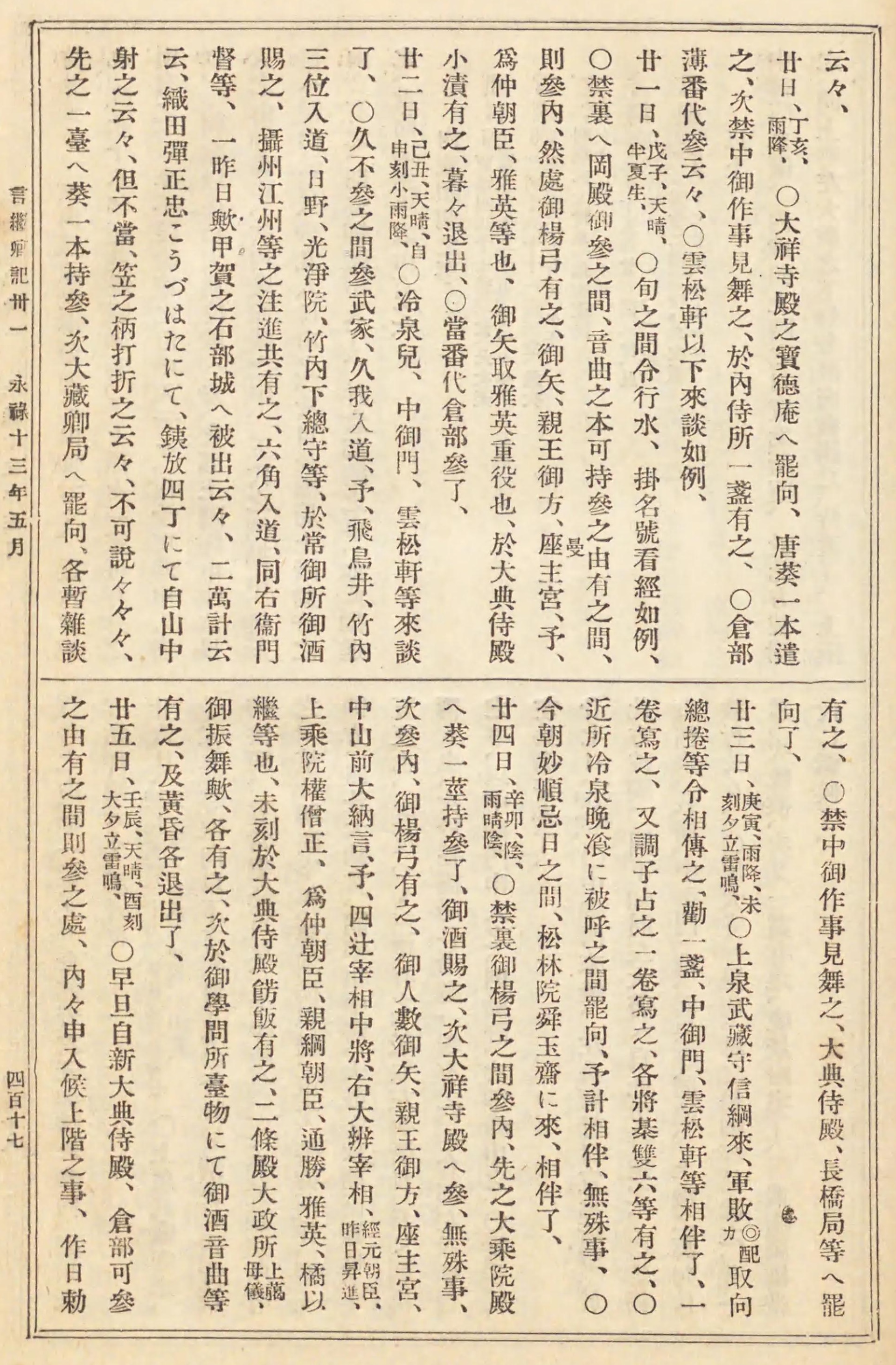
Image source: the National Diet Library Digital Collections copy of the Kokusho Kankōkai edition. Rights holder, reuse conditions, and reproduction permission remain unresolved; display does not assert a licence, public-domain status, or permission to reproduce.
Relevant passage
上泉武藏守信綱來、軍敗〔配カ〕取向、總捲等令相傳之、勸一盞、中御門、雲松軒等相伴了、一卷寫之、又調子占之一卷寫之
- Primary source
- Tokitsugukyōki, Eiroku 13, fifth month, day 23
- Transcription
- 上泉武藏守信綱來、軍敗〔配カ〕取向、總捲等令相傳之、勸一盞、中御門、雲松軒等相伴了、一卷寫之、又調子占之一卷寫之
- Modern rendering / translation
- Kamiizumi Musashi-no-kami Nobutsuna came and transmitted material including gunbai (reading uncertain), torimukai, and sōmaki. A drink was offered with Nakanomikado and Unsōken present; one scroll and another on chōshi divination were copied.
- Interpretation
- Visit, martial transmission, a courtly drinking setting, and textual copying form one documentary sequence. Practice and written transmission occupied the same social encounter. The entry says 一卷寫之 but does not record what was copied.
Eiroku 13, fifth month, day 26
Torimukai for Tokitsugu, Kurabe, and others
Three days later, Kamiizumi visits again. The diary records the transmission of 取向 and further material to Tokitsugu, Kurabe, and others. The activity therefore extended over multiple days rather than a single ceremonial encounter.
The entry does not record what 以下 covers or what roles the participants had.
- Primary source
- Tokitsugukyōki, Eiroku 13, fifth month, day 26
- Transcription
- 上泉武藏守來、予、倉部等取向以下之相傳了
- Modern rendering / translation
- Kamiizumi Musashi-no-kami came; I, Kurabe, and others received transmission of torimukai and the material following it.
- Interpretation
- Tokitsugu and Kurabe are named as recipients in an ongoing sequence of martial transmission.
Rekimei dodai
A separate source joins Kamiizumi, Ogo, and Nobutsuna
Rekimei dodai records the person associated with the Eiroku 13 sixth-month 27 fourth-rank appointment as 上野國上泉住、大胡武藏守 藤信綱. Residence at Kamiizumi, the Ogo Musashi-no-kami designation, and the personal name Nobutsuna occur in one entry.
This is a source separate from Tokitsugukyōki, and it joins in one entry the names the diary records separately.
- Primary source
- Rekimei dodai, entry associated with Eiroku 13, sixth month, day 27
- Transcription
- 上野國上泉住、大胡武藏守 藤信綱
- Modern rendering / translation
- Nobutsuna of the Fujiwara, Ogo Musashi-no-kami, resident at Kamiizumi in Kōzuke Province.
- Interpretation
- Because one notice joins Kamiizumi, Ogo Musashi-no-kami, and Nobutsuna, it provides strong external support for reading the diary forms as one person.
Eiroku 13, sixth month
Fourth rank and a Kyoto network
The sixth-month 17 Oyudono no ue no nikki forms 奉公の千秋, 中の御かと, and かめいつみ, the 27th-day Rekimei dodai entry, and the 28th-day Tokitsugukyōki entry illuminate the court setting from separate records. Reading the three together follows Ito Shinkichi's reconstruction.
On the 28th, Kamiizumi briefly visits to talk. The phrase concerning fourth-rank permission probably relates to the preceding day's appointment. The entry does not say that this permission was a reward for a martial demonstration before the emperor.
- Primary source
- Oyudono no ue no nikki, Eiroku 13, sixth month, day 17; Rekimei dodai, day 27; Tokitsugukyōki, day 28
- Transcription
- 上泉武藏守暫來談、四品勅許忝之由申之
- Modern rendering / translation
- Kamiizumi Musashi-no-kami came briefly to talk and expressed gratitude concerning imperial permission for the fourth rank.
- Interpretation
- Kamiizumi's repeated presence included conversation as well as demonstrations and transmission, placing him near courtly concerns.
Eiroku 13, seventh month, day 19
Yotsutsuji, Itsutsuji, and 調子之占
Yotsutsuji Kōmon, Itsutsuji Shin-kurōdo, and Ogo Musashi-no-kami visit. The two men are said to learn 調子之占 from 武州, naturally read as an abbreviation of Musashi-no-kami.
The phrase echoes the 調子占 scroll copied on the 23rd day of the fifth month. The entry does not record how the practice related to martial training.
- Primary source
- Tokitsugukyōki, Eiroku 13, seventh month, day 19
- Transcription
- 四辻黄門、五辻新藏人、大胡武藏守等來談、兩人武州に調子之占被習之
- Modern rendering / translation
- Yotsutsuji Kōmon, Itsutsuji Shin-kurōdo, Ogo Musashi-no-kami, and others came to talk; the two learned chōshi divination from Musashi-no-kami.
- Interpretation
- Ogo appears as a transmitter of knowledge to two courtiers, revealing an intellectual network that may extend beyond martial technique alone.
Around the palace
Senshū Gyōbu-shōyū / Senshū Terusue
Oyudono no ue no nikki contains the source forms 奉公の千秋, 中の御かと, and かめいつみ. Ito Shinkichi reads these in relation to Senshū Terusue, Nakanomikado Nobunori, and Kamiizumi Nobutsuna when examining martial activity around the palace.
The sources do not describe Senshū as a disciple. He appears alongside Kamiizumi in the martial activity around the palace.
- Primary source
- Relevant Oyudono no ue no nikki entries and research by Ito Shinkichi
- Transcription
- 奉公の千秋/中の御かと/かめいつみ
- Modern rendering / translation
- The source records a Senshū in service, Nakanomikado, and a person written かめいつみ.
- Interpretation
- Ito proposes identifications with Senshū Terusue, Nakanomikado Nobunori, and Kamiizumi Nobutsuna and reconstructs martial activity around the palace.
Eiroku 13, eighth month
Senshū, Ogo, and Suzuki — three martial practitioners
Read together, the entries for the 10th, 18th, and 19th days place Senshū Gyōbu-shōyū, Ogo Musashi-no-kami, and Suzuki in the same sphere of activity. The 19th-day entry explicitly aligns all three with 兵法.
梨門へ御暇乞に参、御盃被下之、御約束之小き錫杖被下之、次千秋刑部少輔、大胡武藏守参、へいはう被御覧了
Senshū Gyōbu-shōyū and Ogo Musashi-no-kami attend, and martial practice is viewed.
千秋刑部少輔、大胡武藏守、鈴木……等來……
The three appear in one visit record; …… marks omitted wording.
千秋、大胡、鈴木等兵法有之、各見物了
The diary records martial activity by Senshū, Ogo, and Suzuki, viewed by those present.
- Primary source
- Tokitsugukyōki, Eiroku 13, eighth month, days 10, 18, and 19
- Transcription
- 千秋、大胡、鈴木等兵法有之、各見物了
- Modern rendering / translation
- There was martial practice by Senshū, Ogo, Suzuki, and others, and those present viewed it.
- Interpretation
- Their repeated co-presence reveals a Kyoto martial network made up of several practitioners.
Kunitakakyōki
From Suzuki to Suzuki Hyōgo-no-suke
Kiyohara Kunitaka's Kunitakakyōki gives 鈴木兵庫助 on the eighth and tenth days of the seventh month of Genki 2. On the eleventh, 上武 and Suzuki visit and the diary records 兵法格位眞砂無刀迄. Ito reads 上武 as an abbreviation for Kamiizumi Musashi-no-kami.
Related evidence supports investigating whether Suzuki was Suzuki Kunitaka. No source connecting Suzuki Hyōgo-no-suke with Suzuki Ihaku has been confirmed.
鈴木兵庫助
The diary records Suzuki with the title Hyōgo-no-suke.
上武・鈴木來、兵法格位眞砂無刀迄遣了
Kiyohara Kunitaka's diary records a visit by 上武 and Suzuki, followed by terms associated with martial transmission.
- Primary source
- Kiyohara Kunitaka's Kunitakakyōki, Genki 2, seventh month, days 8, 10, and 11; research by Ito Shinkichi
- Transcription
- 上武・鈴木來、兵法格位眞砂無刀迄遣了
- Modern rendering / translation
- Jōbu and Suzuki came, and transmitted the martial ranks through masago and mutō.
- Interpretation
- If 上武 is Kamiizumi Musashi-no-kami and Suzuki is Hyōgo-no-suke Kunitaka, the passage records a shared transmission setting.
Everyday records
Drink, conversation, and the Aisu prescription
The Kamiizumi/Ogo of the diary appears not only in transmission but in conversation, drinking, copying, and requests. He looks less like a fixed “sword saint” than a specialist moving through the ordinary life of the city.
Another entry says that an Aisu prescription given the previous year had burned in a fire. At Ogo's request, Tokitsugu wrote it out again and gave him one packet of the medicine. The entry does not indicate who composed the 愛洲藥方 or what it prescribed.
- Primary source
- The Aisu medicine entry in Tokitsugukyōki
- Transcription
- 大胡武藏守來、愛洲藥方去年遣之、火事燒之間又所望之由申之間書遣之、同藥一包遣之
- Modern rendering / translation
- Ogo Musashi-no-kami came. Because the Aisu prescription sent the previous year had burned in a fire, he requested it again; it was copied and sent, together with one packet of the medicine.
- Interpretation
- The network around this martial practitioner also involved preserving and replacing texts and exchanging medical knowledge.
Genki 2, seventh month, day 21
The letter of introduction to the Yuki party
The person preparing to return home is 大胡武藏守 in the diary narrative and asks for a letter to the Yuki party of Shimotsuke. The copied letter then calls its subject 上泉武藏守. This continuous setting is the strongest evidence for identifying the two forms as one person.
The letter describes his arrival in Kyoto, martial transmission to the shogun and others, 無比類發名, and 同流一家. It is weighty third-party testimony by Tokitsugu. The diary writes 下野國結城方 without naming an individual.
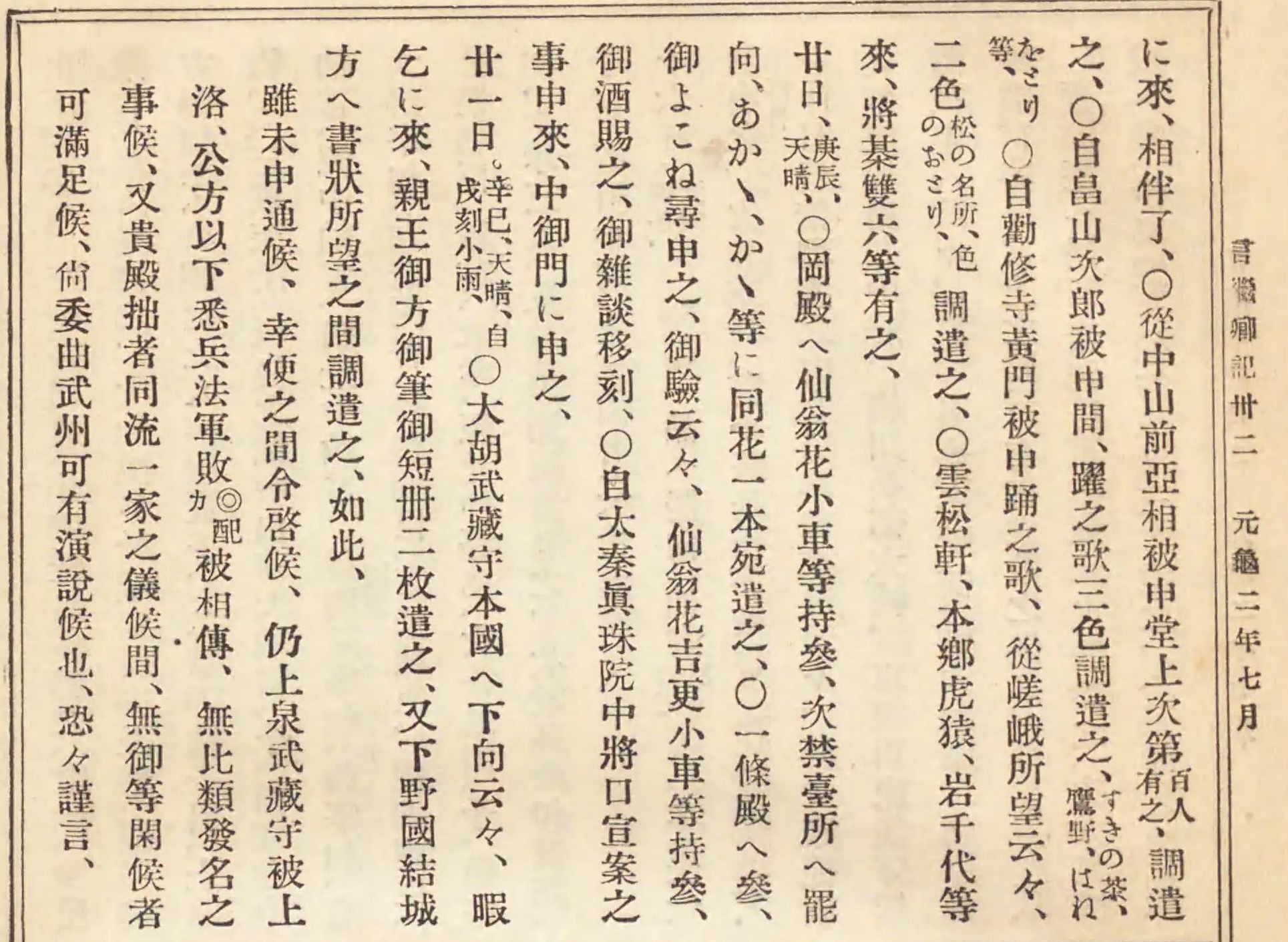
Image source: the National Diet Library Digital Collections copy of the Kokusho Kankōkai edition. Rights holder, reuse conditions, and reproduction permission remain unresolved; display does not assert a licence, public-domain status, or permission to reproduce.
Diary narrative
大胡武藏守本國へ下向云々、暇乞に來……又下野國結城方へ書狀所望之間調遣之、如此
Letter copied within the entry
仍上泉武藏守被上洛、公方以下悉兵法軍敗〔配カ〕被相傳、無比類發名之事候、又貴殿拙者同流一家之儀候間……
- Primary source
- The diary narrative and copied letter in Tokitsugukyōki, Genki 2, seventh month, day 21
- Transcription
- 大胡武藏守本國へ下向云々、暇乞に來……又下野國結城方へ書狀所望之間調遣之、如此/仍上泉武藏守被上洛、公方以下悉兵法軍敗〔配カ〕被相傳、無比類發名之事候、又貴殿拙者同流一家之儀候間……
- Modern rendering / translation
- Ogo came to take leave before returning home and requested a letter to the Yuki party. The letter records Kamiizumi's arrival in Kyoto; that martial material including 兵法 and 軍敗〔配カ〕 was transmitted to the shogun and others; 無比類發名; and a 同流一家 relation between its recipient and Tokitsugu.
- Interpretation
- Because requestor and subject are joined within one entry, contextual identification of 大胡武藏守 and 上泉武藏守 is exceptionally strong.
Scope examined
Does Shinkage-ryu occur in the 91 pages?
No confirmed occurrence of 陰流, 影流, 新陰流, or 新影流 was found in the 91 pages of Tokitsugukyōki examined for this study. The diary directly supports a person and his martial activity, not the school name.
伊勢守 likewise does not appear in the Kamiizumi-related passages examined here. The examined scope was 91 pages, not the whole of Tokitsugukyōki.
- Primary source
- The 91 pages of Tokitsugukyōki examined for this study
- Transcription
- No confirmed occurrence of 陰流, 影流, 新陰流, or 新影流 was found.
- Modern rendering / translation
- Within the search scope, no passage was found naming the art Shinkage-ryu.
- Interpretation
- What the diary directly records is a contemporary person and his martial activity. The school name Shinkage-ryu appears in later documents.
Part II
Kamiizumi Musashi-no-kami in Shinkage-ryu and Hikita-den transmissionRead as later transmission, documentary, and research layers distinct from the contemporary reconstruction.A — Transmitted lineage
Position in the transmitted lineage
In the lineage transmitted within Shinkage-ryu Hikita-den, 上泉武蔵守 is positioned between 愛洲小七郎 and 疋田栖雲斎.
The portion currently confirmed in the lineage material held by Fukuoka City Museum records 愛洲移香, 愛洲小七郎, 上泉武蔵守, and 疋田栖雲斎 in that order.
This source writes 上泉武蔵守, while the contemporary diary records the fuller form 上泉武藏守信綱. The broader transmitted lineage on the site continues through later entries.
B / C — Source and scholarship
上泉武蔵守 and Shinkage-ryu
上泉 appears in both documentary and scholarly material as a figure connected with the formation and transmission of Shinkage-ryu. One lead is the text traditionally known as 燕飛序.
Scholarship cites a statement attributed to 上泉: 予究諸流奥源於陰流/別抽出奇妙号新陰流. The passage says that he studied the various traditions, traced their source to Kage-ryu, and from that named something new 新陰流.
The manuscript lineage and circumstances of composition of 燕飛序 are not currently known.
A / C — Tradition and scholarship
Relationship with Kage-ryu
Aisu Kage-ryu material, research concerning 燕飛序, and comparisons of form names provide evidence for examining the relationship between Kage-ryu and the Shinkage-ryu associated with 上泉.
The surviving material provides clues to a relationship between Kage-ryu and 上泉's Shinkage-ryu. No source showing specifically from whom, when, or where 上泉 learned it has been confirmed.
A / C — Tradition and scholarship
Relationship with 愛洲小七郎
The Shinkage-ryu Hikita-den transmitted lineage places 上泉武蔵守 after 愛洲小七郎.
No source establishing that 愛洲小七郎 and 宗通 were the same person has been confirmed. The date, place, and content of any transmission to 上泉 are likewise not known.
A / C — Tradition and names
Relationship with 疋田栖雲斎 / 疋田豊五郎
The Shinkage-ryu Hikita-den transmitted lineage places 疋田栖雲斎 after 上泉武蔵守. 栖雲斎 is a gō of 疋田豊五郎, the form used in research literature and other materials.
Because each source's wording is shown as written, quotations carry 疋田栖雲斎, 疋田豊五郎, and 疋田殿 side by side.
B / C — Names by source
Names appearing in sources
The contemporary diary 言継卿記 explicitly records 上泉武藏守信綱 in its entry for Eiroku 13, fifth month, day 23 (1570). 信綱 was therefore recorded during Kamiizumi's lifetime.
In the later Hikita-line transmission, a Keichō 5 (1600) Shinkage-ryu document associated with 疋田豊五郎入道景兼 records 上泉武蔵守 and 藤原信綱朝臣 in its lineage notation. Though not contemporary with Kamiizumi himself, it is relatively early Hikita-line evidence for the use of 信綱.
By contrast, the colophon to the version of 兵法家伝書・活人剣 transmitted from 柳生宗矩 to 細川忠利 in Kan'ei 14 (1637) records 上泉武蔵守藤原秀綱. It continues with 亡父柳生但馬守平宗厳, 的子柳生但馬守平宗矩(花押), 寛永十四年丁丑五月吉日, and 細川越中守殿 参. 秀綱 is a form confirmed in a Yagyu-line transmission record.
The contemporary record and the early Hikita-line transmission give 信綱, while the later Yagyu-line record gives 秀綱. How the two forms relate, and which arose first, is not currently known.
The Nippon Kobudo Association profile of Yagyu Shinkage-ryu lists 印可状(上泉伊勢守自筆相伝書) and 新陰流 影目録 四巻(同右) among materials transmitted by the Yagyu family. The attribution 自筆 (autograph) is the association's own description of the material.
Sources and references: Tokitsugukyōki (『言継卿記』), vol. 4 · Supplied excerpts from 『言継卿記』 · Keichō 5 Shinkage-ryu transmission document associated with 疋田豊五郎入道景兼 · 1637 colophon to 『兵法家伝書・活人剣』
B / A / D — Source, tradition, and comparison
Research questions from technical transmission
The Aisu Kage-ryu material and the Hikita-related material share the same six entries from 猿飛 through 浦波 in name and order. The Aisu Kage-ryu sequence continues beyond those six.
新陰流(疋田伝)の研究 publishes 新陰之流猿飛の目録 under the description 疋田殿自筆書, with the same six names in the same order. The authorship and provenance of that original have not been confirmed.
The detailed comparison with the surviving Kage-ryu documents is treated in Chapter 1.
C / D — Scholarship and comparison
参学 and 三学
The Hikita transmission writes the set name as 参学, while other Shinkage-ryu lineages write 三学. The constituent form names differ, and differences are also found in the forms as they are transmitted today. 新陰流(疋田伝)の研究 includes 新陰之流参学の巻. This question is examined separately.
C — Research and bibliography
Research and bibliography
軽米克尊's 2014 University of Tsukuba doctoral dissertation 直心影流に関する研究 examines Kage-ryu influence, 燕飛序, differing transmission traditions, and form-name comparison. The report by 宮本光輝 and 魚住孝至 and 新陰流(疋田伝)の研究 publish source images and transcriptions.
Next chapter
A martial practitioner in contemporary records
Following Tokitsugukyōki, 大胡武藏守 first appears in Tokitsugu's ordinary record of visits; the diary later records 上泉武藏守 and 上泉武藏守信綱. As the entries continue, they describe transmission involving 取向 and 總捲, drinking, textual copying, and encounters with courtiers and other martial practitioners.
Nakanomikado, Unsōken, Yotsutsuji, Itsutsuji, Senshū, and Suzuki enter this circle. In an August entry, three of the names appear together in 千秋、大胡、鈴木等兵法有之. Another entry records Ogo's request for the 愛洲藥方 after it had burned in a fire.
Then, in Genki 2, as he prepared to return home, 大胡武藏守 in the diary narrative and 上泉武藏守 in the copied letter are joined within one continuous context.
To whom, then, did this martial practice pass? No person identifiable as Hikita Bungoro has yet appeared in the group of Kyoto records concerning Kamiizumi examined here. Chapter 3 shifts the viewpoint to Hikita and follows the documents directly connected with him.
Sources
Primary material, edition, and research
Primary material
- 山科言継『言継卿記』第四Kokusho Kankōkai, Taishō 4 (1915)Scope checked: the displayed passages for Eiroku 13, fifth month, day 23 and Genki 2, seventh month, day 21 were directly checked against page reproductions of the published edition. The manuscript, full entries, printed page and scan-frame locators, and other excerpts were not checked; no transcription of all 91 pages was checked.
- 『お湯殿の上の日記』Contemporary entries concerning Senshū and Kamiizumi; source forms are retained.The Ito Shinkichi studies listed under Related scholarshipScope checked: transcriptions and quotations published in secondary scholarship were reviewed. Images of the original source were not checked. The item-level paper and page mapping remains unregistered.
- 『歴名土代』Records 上野國上泉住、大胡武藏守 藤信綱.The Ito Shinkichi studies listed under Related scholarshipScope checked: transcriptions and quotations published in secondary scholarship were reviewed. Images of the original source were not checked. The item-level paper and page mapping remains unregistered.
- 清原国賢『国賢卿記』Genki 2 seventh-month entries concerning 上武, Suzuki, and Suzuki Hyōgo-no-suke.The Ito Shinkichi studies listed under Related scholarshipScope checked: transcriptions and quotations published in secondary scholarship were reviewed. Images of the original source were not checked. The item-level paper and page mapping remains unregistered.
The displayed images reproduce the printed Kokusho Kankōkai edition; they are not photographs of the original manuscript.
Related scholarship
- 伊藤信吉「上泉信綱と千秋輝季の関係について(上)」Kogakkan Ronso 47.1 (2014), pp. 36–57
- 伊藤信吉「上泉信綱と千秋輝季の関係について(下)」Kogakkan Ronso 47.2 (2014), pp. 1–24
- 伊藤信吉「上泉信綱小考」Kogakkan Ronso 47.6 (2014), pp. 33–70
- 伊藤信吉「千秋輝季の伝記的研究」Kogakkan Ronso 48.3 (2015), pp. 26–47
Editorial method
Dates retain the source's lunisolar form, with only the corresponding Western year supplied. Transcriptions preserve variant and uncertain characters; translations and scholarly identifications appear in separate layers.
Reviewed Shinkage-ryu and Hikita-den material
Each card states only its reviewed scope; it does not imply review of the complete text or original source.
NDL volume-level digital record verified · relevant pages and scan frames not yet mapped
Tokitsugukyōki (『言継卿記』), vol. 4
- Author
- 山科言継
- Form reviewed
- Digitized copy of the Kokusho Kankōkai edition
- Institution
- National Diet Library Digital Collections
- Bibliographic details
- Kokusho Kankōkai edition
- Digital access
- View in National Diet Library Digital Collections
Volume-level access record for consulting the historical diary 『言継卿記』 through the National Diet Library's digitized copy of the Kokusho Kankōkai edition. It is not the original manuscript. Publication year, editor, relevant pages, scan frames, and mappings to individual excerpts remain unregistered.
Supplied confirmed excerpts reviewed · independent collation with the edition pending
Supplied excerpts from 『言継卿記』
- Author
- 山科言継
- Form reviewed
- Confirmed excerpts and entry summaries supplied for this revision
The supplied research identifies these excerpts as confirmed. The entry naming 上泉武藏守信綱 is dated Eiroku 13, fifth month, day 23. Its relevant printed page and scan frame, and the exact dates of the other entries, remain unresolved; this site has not independently collated them against a manuscript or critical edition. Supplied forms such as 藏, 總, 捲, and 軍敗 and the omission marks are retained. The letter was supplied approximately and is not a settled transcription.
Supplied transcription reviewed · original source not examined
Keichō 5 Shinkage-ryu transmission document associated with 疋田豊五郎入道景兼
- Figure named in text
- 疋田豊五郎入道景兼
- Form reviewed
- Supplied transcription of the lineage notation
- Catalogue date
- Keichō 5 (1600)
The supplied lineage notation in a Shinkage-ryu transmission document associated with 疋田豊五郎入道景兼 records 上泉武蔵守 and 藤原信綱朝臣. It is not a contemporary record from Kamiizumi's lifetime, but is treated as relatively early Hikita-line evidence for 信綱. The original's location, provenance, and complete text have not been verified.
Supplied transcription reviewed · original source not examined
1637 colophon to 『兵法家伝書・活人剣』
- Author
- 柳生宗矩
- Figure named in text
- 上泉武蔵守・柳生宗厳・柳生宗矩・細川忠利
- Form reviewed
- Supplied transcription of a Yagyu-line colophon
- Catalogue date
- Kan'ei 14, fifth month (1637)
In the supplied transcription of the colophon to the Katsuninken transmitted from 柳生宗矩 to 細川忠利, 上泉武蔵守藤原秀綱 is followed by 亡父柳生但馬守平宗厳, 的子柳生但馬守平宗矩(花押), 寛永十四年丁丑五月吉日, and 細川越中守殿 参. This establishes the presence of 秀綱 in a Yagyu-line transmission record; it does not decide whether the form is an error, an alternate name, or the result of a name change. The original characters, provenance, and variant copies have not been verified.
Registered source · confirmed transcription
新陰流形組絵図
- Holding institution
- Fukuoka City Museum
- Reviewed scope
- The written form 上泉武蔵守 and the four-name sequence
The reviewed names come from the lineage section of 新陰流形組絵図 held by Fukuoka City Museum.
The displayed lineage section and 眼勝 are partial images of the source held by the museum; neither represents the complete handscroll.
Public catalogue information reviewed · detailed contents not examined
愛洲陰流伝書・新当流奥三ッ太刀
- Institution
- Tokyo National Museum
- Catalogue date
- Muromachi period; 16th-century copy
Title, institution, period, and copy date reviewed from public catalogue information; detailed contents not yet examined.
Quoted passage reviewed in scholarship · original source not examined
足利義昭期の武家訴訟における禁裏の役割と権威の実効性
- Institution
- Meiji University Academic Repository
The paper's quotation of 大胡武蔵守 in the 15th day of the first month of Eiroku 12 (1569) entry of 言継卿記 was reviewed; the diary manuscript and an authoritative edition have not been examined directly.
Institutional description reviewed · not independent authentication
柳生新陰流 (tradition profile)
- Institution
- Nippon Kobudo Association
The institutional profile lists 印可状(上泉伊勢守自筆相伝書) and 新陰流 影目録 四巻(同右) among Yagyu-transmitted materials; this is not treated as independent palaeographic authentication.
Relevant sections reviewed · scholarly interpretation
直心影流に関する研究
- Author
- 軽米克尊
- Institution
- University of Tsukuba
- Catalogue date
- 2014
- Bibliographic details
- Doctoral dissertation in Physical Education, Health and Sport Sciences; no. 6993
Relevant sections concerning Kage-ryu, Shinkage-ryu, 燕飛序, differing transmission accounts, and kata-name comparison were used as scholarly interpretation.
Published reproduction and discussion reviewed · original source not examined
愛洲陰之流目録の調査報告―新陰流との関係及び『紀效新書』所載の『影流之目録』についての新知見―
- Author
- 宮本光輝・魚住孝至
Published images, transcription, and research discussion of 猿飛 in the Aisu Kage-ryu material were reviewed; the complete source and its provenance require separate examination.
Published reproduction and discussion reviewed · original source not examined
新陰流(疋田伝)の研究
- Author
- 赤羽根龍夫・赤羽根大介
- Institution
- Kanagawa Dental College
- Catalogue date
- 2007
- Bibliographic details
- Bulletin of Liberal Arts and Science 25, pp. 1–118; DOI 10.18924/00000388
Published Hikita-related and later transmission materials were reviewed. For Bungorō's biography, the statements on p. 1 concerning an approximate Tenbun 4 birth, Kaga, parentage, and 景兼, and the 350-koku statement on p. 10 were checked in page images; no claim-specific primary-source citation was identified on those pages. For the 上野 identity audit, the lineage diagram on p. 11 attributed to 肥後武道史, the OCR false positive on p. 39, and the typeset Hayashi-family transcription on p. 89 were checked visually and kept in separate evidence layers. The original sources' provenance, authorship, dates, and transcription decisions have not been independently verified.
Unverified matters
This article presents the explicit name 上泉武藏守信綱, visits and transmission, and Tokitsugu’s letter describing arrival in Kyoto. Further review is needed to map each excerpt to the relevant pages and NDL scan frames in volume four of the Kokusho Kankōkai edition; to collate the dates, wording, and contexts of entries not checked directly against page reproductions; to settle the letter’s text; to find any direct equation with 大胡武蔵守; and to establish correspondence with forms such as 上泉伊勢守 and 秀綱. Exact life dates, origin, family, service, a complete itinerary, rank, popular stories, and pupil lists have not been supplied to the canonical person data.
Direct instruction by 愛洲小七郎, direct instruction of 疋田豊五郎, transmission dates and locations, unchanged technical continuity, the manuscript history of 燕飛序, and the authorship and provenance of material described as 疋田殿自筆書 also remain unverified.
Full text not examined · sources for further research
- 『言継卿記』永禄12年正月15日条manuscript or authoritative edition
- 『言継卿記 第四』と今回の提供抜粋relevant pages, scan frames, dates, uncertain readings including 軍敗, and the letter's full text and date
- 大胡武蔵守の同定に関する研究・事典individual bibliographic records, passages, identification arguments, and primary evidence
- 『燕飛序』text, manuscript history, and formation
- 柳生家伝来『新陰流 影目録』direct examination where possible
- 上泉の諱・受領名の変遷資料the chronology and transmission of 信綱/秀綱 and 武蔵守/伊勢守
- 愛洲小七郎と上泉武蔵守の関係資料specific transmission relationship
- 上泉と疋田豊五郎の関係資料specific transmission relationship
- 猿飛・燕飛関係資料transcription and sequence comparison by tradition
- 参学・三学関係資料transcription and form-name comparison by tradition
- 「疋田殿自筆書」とされる資料independent provenance and authorship review
- 上泉の生涯に関する地域史料location, text, and historical context